
How to Master Sports Commentary in English – A Practical Guide for Learners
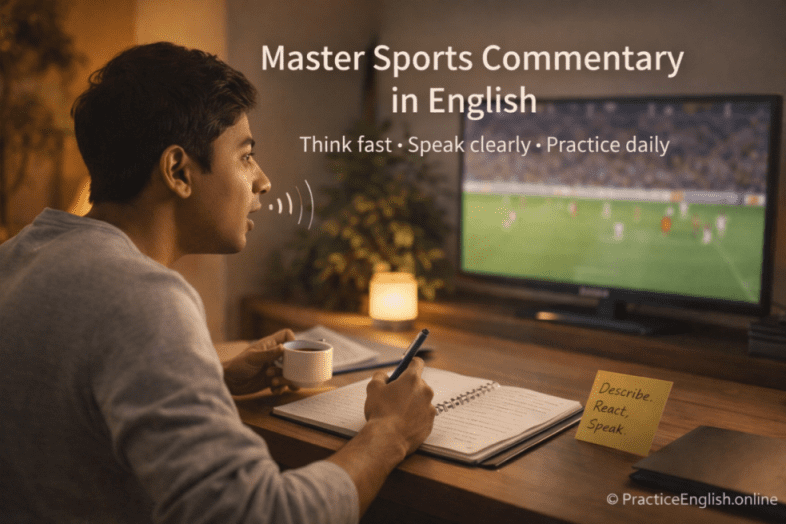
Sports commentary is one of the most powerful and enjoyable ways to improve spoken English.
Why?
Because it is real, fast, emotional, and repetitive — exactly how English is spoken in real life.
If you’ve ever watched a cricket match, football game, or even a highlights reel and thought:
“I understand this in Hindi, but I can’t say it in English”
“Commentators speak so fluently — how do they do it?”
“Can I ever speak English like that?”
This guide is for you.
You don’t need to become a professional commentator.
You just need to train your brain the way commentators think and speak.
Let’s break it down step by step.
Why Sports Commentary Is a Powerful Way to Learn English
Most people try to learn English like this:
grammar rules
long word lists
memorising essays
But spoken English doesn’t work that way.
Sports commentary works because:
1. It trains real-time thinking
Commentators don’t get time to plan sentences.
They speak as the action happens.
This is exactly what we struggle with in daily conversations.
2. The language is repetitive
Phrases repeat again and again:
“He goes for the shot”
“That’s a great effort”
“They need 10 runs from the last over”
Repetition builds fluency without memorising rules.
3. Emotions make learning stick
Excitement, tension, disappointment — emotions help your brain remember language faster.
Step 1: Understand Commentary Language (It’s Simpler Than You Think)
Many learners believe commentary English is “advanced”.
In reality, most commentary uses simple sentence structures.
Example:
Instead of:
“The batsman executed a technically sound stroke”
Commentators usually say:
“That’s a lovely shot.”
Or:
“He timed that beautifully.”
Simple. Natural. Powerful.
👉 Fluency comes from clarity, not complexity.
Step 2: Start with Descriptive Commentary (Beginner Level)
Before adding emotions or opinions, learn to describe what you see.
This is the easiest and safest starting point.
Cricket example:
“The bowler runs in.”
“The batsman plays a defensive shot.”
“No run taken.”
Football example:
“He passes the ball.”
“The defender clears it.”
“The crowd reacts.”
🔑 Rule: Say what is happening. Don’t judge it yet.
Step 3: Add Time & Situation Awareness (Intermediate Level)
Now start adding context.
Commentators always mention:
time
score
pressure
situation
Examples:
“They need 15 runs from the last over.”
“This is a crucial moment in the match.”
“He comes in under pressure.”
This teaches you how to:
connect sentences
explain situations clearly
speak beyond single lines
Step 4: Learn Emotion & Opinion Language (Advanced Level)
This is where commentary becomes exciting.
Commentators don’t just describe — they react.
Common opinion phrases:
“That’s a risky shot.”
“He’s shown great composure.”
“This could change the game.”
Notice:
short sentences
strong verbs
confident tone
👉 You don’t need difficult words.
You need confidence and flow.
Step 5: Think in Hindi → Speak in English (Correctly)
Most Indian learners think in Hindi first.
That’s normal. Don’t fight it — use it.
Example:
Hindi thought:
“Yeh shot match palat sakta hai”
Natural English:
“This shot could turn the match around.”
Not:
❌ “This shot can rotate the match.”
This is where Hindi-to-English practice sentences become extremely useful.
If you already have a Hindi → English translation PDF, use it like this:
Read the Hindi sentence
Pause for 3 seconds
Speak the English sentence aloud
Repeat it during live match moments
Step 6: Practice with Mute Commentary (Most Powerful Technique)
This is a game-changer.
How to do it:
Play a match or highlights
Mute the sound
Speak your own commentary in English
Start slow:
one sentence per action
don’t worry about mistakes
This trains:
real-time thinking
sentence formation
speaking without fear
Step 7: Build Your Own Commentary Phrase Bank
Don’t memorise vocabulary.
Collect usable phrases.
Examples:
“That’s well played.”
“He’s taken a chance.”
“The pressure is building.”
“They are back in the game.”
Practice saying them:
aloud
during matches
while watching highlights
Step 8: Common Mistakes Learners Make
❌ Trying to sound too advanced
Fluency comes from simple clarity, not big words.
❌ Waiting to be perfect
Commentary is fast. Mistakes are normal.
❌ Only watching, not speaking
English improves only when you speak, not when you watch silently.
Step 9: How Often Should You Practice?
Consistency matters more than time.
Ideal routine:
10–15 minutes daily
one short clip or over
speak aloud, not in your head
Even 5 minutes a day beats one long session a week.
How PracticeEnglish.online Helps You Master Commentary English
At PracticeEnglish.online, we focus on real speaking practice, not theory.
You can:
practice Hindi → English sentences
speak in live group sessions
get gentle corrections
build confidence without judgment
👉 You can practice English for free, or
👉 join guided paid sessions for structured improvement.
🔗 Visit: https://practiceenglish.online/
Final Thought
You don’t master sports commentary by learning English first.
You master English by speaking it through commentary.
Start small.
Speak daily.
Use real situations.
And one day, you’ll realise:
“I’m not translating anymore — I’m speaking naturally.”
That’s mastery.