
Fear of Speaking English: 8 Hidden Causes & Proven Solutions to Overcome It
Meera sits in the conference room, her heart pounding. Her manager just asked her to share the project update. She knows exactly what to say—she rehearsed it three times this morning. But the moment she opens her mouth, her throat tightens. Her hands tremble. Words that flowed smoothly in her mind suddenly refuse to come out.
She stammers, “I… uh… the project is… we have…” Her colleagues wait patiently, but Meera can feel their eyes on her. Finally, her manager says, “It’s okay, Meera. Email me the update instead.”
Does this sound familiar?
If you’ve ever felt your heart race, your palms sweat, or your mind go blank when you need to speak English, you’re not alone. The fear of speaking English affects over 70% of non-native speakers worldwide, and in India, this number is even higher.
Today, we’re going to uncover the real reasons behind this fear and, more importantly, show you exactly how to overcome it.
8 Hidden Causes Behind Your Fear of Speaking English
Cause 1: The “Judgment Trap” – Fear of Being Mocked or Criticized
The Reality: “What if they laugh at my accent?”
“What if I use the wrong word?”
“What if I sound stupid?”
Raj from Bangalore shares his experience: “In my first team meeting, I mispronounced ‘particularly’ as ‘partickly.’ One colleague smiled. Just a small smile. But I was so embarrassed that I didn’t speak in meetings for two months.”
Why This Happens:
- We’ve seen or experienced people being mocked for poor English
- Social media and movies often portray incorrect English as “funny”
- In India, English proficiency is sometimes used to judge intelligence
- Past negative experiences create lasting fear
The Impact: This fear creates a vicious cycle:
- You fear judgment
- You avoid speaking
- You don’t practice
- Your English doesn’t improve
- Your fear increases
Cause 2: Perfectionism – The “All or Nothing” Mindset
The Reality: Many Indians believe: “If I can’t speak perfectly, I shouldn’t speak at all.”
Priya, an engineering graduate, says: “I scored 92% in English throughout school. But I can’t speak fluently, so I feel like a failure. It’s better to stay quiet than to expose my weakness.”
Why This Happens:
- Our education system rewards perfection (90%+ marks)
- We compare ourselves to native speakers or movie characters
- We think fluency means zero mistakes
- We set unrealistic standards for ourselves
The Truth: Native English speakers make grammatical errors ALL THE TIME. They use slang, incomplete sentences, and break grammar rules constantly. Yet we hold ourselves to impossible standards.
Cause 3: Limited Practice Opportunities Create Performance Anxiety
The Reality: You practice English in your mind but rarely speak it aloud. So when an actual English-speaking situation arises, your brain treats it as a “high-stakes performance” rather than a normal conversation.
Why This Happens:
- Most Indians speak their mother tongue 90-95% of the time
- English is used only in formal situations (interviews, presentations, office)
- We don’t have casual English conversations regularly
- Each English-speaking opportunity feels like an exam
The Impact: When you speak English only in formal situations:
- Your brain associates English with stress
- You can’t develop natural, flowing speech
- Every conversation feels like a test
- Anxiety becomes your default response
Cause 4: Translation Lag Increases Anxiety
The Reality: While you’re translating from Hindi/Tamil/Telugu to English in your mind, the conversation moves forward. You fall behind, panic sets in, and fear takes over.
Why This Creates Fear:
- You feel slow compared to others
- You worry about long pauses
- You fear losing the conversation thread
- You become self-conscious about your processing time
Cause 5: Past Negative Experiences Create Lasting Fear
The Reality: One embarrassing incident can create years of fear.
Amit recalls: “In 10th standard, I read aloud in class and mispronounced ‘chaos’ as ‘cha-os.’ The whole class laughed. I’m 28 now, and I still hesitate before saying any difficult word.”
Why Past Experiences Have Such Power:
- Our brains are wired to remember negative experiences more vividly
- Embarrassment creates strong emotional memories
- These memories activate whenever similar situations arise
- The fear becomes automatic and unconscious
The Problem: Your brain tries to “protect” you from future embarrassment by triggering anxiety whenever you need to speak English. This is a survival mechanism gone wrong.
Cause 6: Comparing Yourself to Others
The Reality: You compare your English to:
- Your colleague who studied in an English-medium school
- Your friend who lived abroad
- Movie stars and news anchors
- Native English speakers
Why This Fuels Fear: When you compare your beginning to someone else’s middle or end:
- You feel inadequate
- You believe you’ll never “catch up”
- You focus on the gap rather than your progress
- You convince yourself you’re “not good at English”
Sneha from Mumbai says: “My teammate speaks such fluent English. I feel like I’ll never speak like her, so why even try?”
Cause 7: High-Stakes Situations Multiply the Fear
The Reality: The fear isn’t just about speaking English—it’s about what’s at stake.
High-stakes situations in India:
- Campus placement interviews (your entire career depends on 15 minutes)
- Client presentations (your job depends on this)
- First day at a new job (making a good impression)
- Speaking to senior management (career growth opportunity)
- International calls (representing your company)
When the stakes are high, fear multiplies because:
- The consequences feel enormous
- You can’t afford to make mistakes
- You have one chance to get it right
- Your future seems to depend on this moment
Cause 8: Lack of a Supportive Practice Environment
The Reality: You need a safe space to practice, make mistakes, and improve. But most Indians don’t have access to:
- Patient conversation partners
- Non-judgmental practice environments
- Constructive feedback
- Regular speaking opportunities
Why This Matters: Without a supportive environment:
- You can’t build confidence gradually
- Every speaking opportunity feels risky
- You avoid practice altogether
- Fear compounds over time
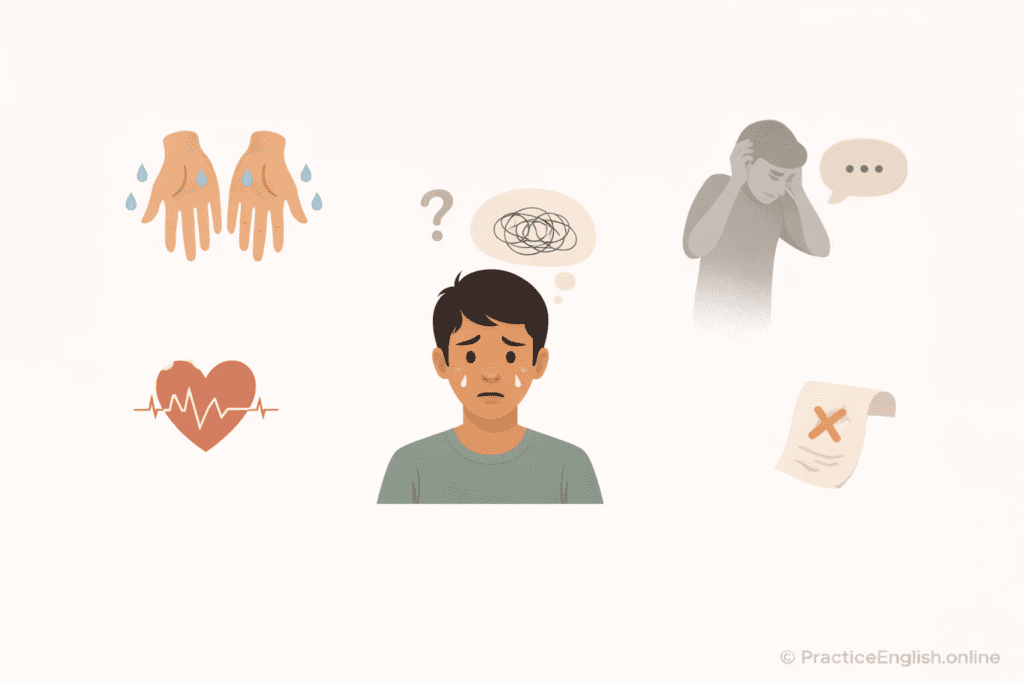
The Physical Symptoms: What Fear Does to Your Body
When you’re about to speak English, do you experience:
Physical Symptoms:
- ✓ Rapid heartbeat
- ✓ Sweating palms
- ✓ Dry mouth
- ✓ Shaky voice
- ✓ Trembling hands
- ✓ Difficulty breathing
- ✓ Tight throat
- ✓ Stomach butterflies
- ✓ Blushing
Mental Symptoms:
- ✓ Mind going blank
- ✓ Forgetting simple words
- ✓ Inability to think clearly
- ✓ Racing thoughts
- ✓ Negative self-talk (“I’m going to mess this up”)
Behavioral Symptoms:
- ✓ Avoiding English-speaking situations
- ✓ Speaking very quietly
- ✓ Rushing through sentences
- ✓ Using very short answers
- ✓ Letting others speak instead
These are classic signs of speaking anxiety, and they’re completely normal. Your body is responding to what it perceives as a threat.
The Cost of This Fear: What You’re Losing
This fear isn’t just uncomfortable—it’s costly.
Career Impact:
- Missing out on job opportunities (80% of MNCs require strong English)
- Not speaking up in meetings (losing visibility and promotions)
- Avoiding leadership roles
- Lower salary negotiations (can’t articulate your value)
- Limited career growth
Personal Impact:
- Low self-esteem and confidence
- Social isolation (avoiding English-speaking friends)
- Missed networking opportunities
- Inability to travel confidently
- Academic limitations (presentations, group discussions)
Financial Impact: Research shows that strong English speakers in India earn 30-40% more than those with poor English skills in the same roles.
That fear? It’s literally costing you money.
Breaking Free: 10 Proven Solutions to Overcome Your Fear
Now for the good news: This fear is completely conquerable. Thousands of Indians have overcome this exact fear and now speak English confidently. Here’s how:
Solution 1: Reframe Your Mindset – Communication Over Perfection
The Shift: From: “I must speak perfect English”
To: “I need to communicate my message clearly”
How to Do This:
- Focus on getting your point across, not on perfect grammar
- Remember: even native speakers make mistakes
- Value connection over correctness
- Celebrate successful communication, not perfect sentences
Practice Exercise: Next time you speak English, ask yourself: “Did they understand what I meant?” If yes, you succeeded—regardless of grammar mistakes.
Solution 2: Start Small – Micro-Wins Build Confidence
The Strategy: Don’t try to conquer your fear overnight. Build confidence through small, manageable steps.
The Ladder Approach:
Step 1 (Safest):
- Speak English alone (describe your day to yourself)
- Record voice messages in English on your phone
- Read aloud from books or articles for 5 minutes daily
Step 2:
- Speak English with one trusted friend or family member
- Practice common conversations (ordering food, asking for directions)
- Use English in low-stakes situations (talking to shopkeepers)
Step 3:
- Join online English practice groups
- Speak in small group settings (3-4 people)
- Volunteer to read aloud in meetings
Step 4:
- Present in team meetings
- Make phone calls in English
- Speak at larger gatherings
Step 5:
- Lead presentations
- Conduct interviews in English
- Speak at conferences or public events
The Key: Don’t skip steps. Master each level before moving to the next. Each small win reduces fear and builds confidence.
Solution 3: Practice in a Safe, Non-Judgmental Environment
Why This Works: When you practice in a supportive environment, your brain learns that “speaking English = safe” rather than “speaking English = danger.”
What a Safe Environment Looks Like:
- No one laughs at mistakes
- Corrections are kind and constructive
- Everyone is learning together
- The focus is on improvement, not comparison
- You can ask questions without embarrassment
Discover how role-play practice in a supportive setting can transform your speaking confidence.
At PracticeEnglish.Online: Our coaches create exactly this environment. They understand Indian learners’ fears because they’ve been there themselves. You can make mistakes freely, ask “stupid” questions, and practice without judgment.
Solution 4: Desensitization Through Gradual Exposure
The Psychology: Repeated exposure to feared situations, in controlled doses, reduces fear over time. This is called systematic desensitization.
How to Apply This:
Week 1-2: Speak English for 5 minutes daily in a completely safe situation (alone or with one supportive person)
Week 3-4: Speak English for 10-15 minutes daily with 2-3 people
Week 5-6: Participate in small group conversations (4-5 people)
Week 7-8: Speak in slightly uncomfortable situations (asking strangers for help in English)
Week 9-10: Present to small groups or join speaking clubs
The Rule: Each exposure should be challenging but not overwhelming. You want mild discomfort, not panic.

Solution 5: Use Breathing Techniques to Calm Physical Symptoms
The Science: When you’re anxious, your breathing becomes shallow. This triggers more anxiety. Controlled breathing activates your parasympathetic nervous system, which calms you down.
The 4-7-8 Technique (do this before speaking):
- Breathe in through your nose for 4 counts
- Hold your breath for 7 counts
- Exhale through your mouth for 8 counts
- Repeat 3-4 times
The Box Breathing Method (during speaking):
- Breathe in for 4 counts
- Hold for 4 counts
- Breathe out for 4 counts
- Hold for 4 counts
- Repeat
Quick Calming Technique: Before you speak, take 3 deep breaths. This signals your brain: “We’re safe. We can do this.”
Solution 6: Prepare and Practice Difficult Situations in Advance
The Strategy: Fear reduces when you know what to expect and how to handle it.
How to Prepare:
For Interviews:
- List 10 most common interview questions
- Prepare and rehearse answers
- Practice with a friend or coach
- Record yourself and watch playback
- Prepare backup phrases for when you’re stuck
For Presentations:
- Write your script completely
- Practice aloud 5-10 times
- Practice in front of a mirror
- Time yourself
- Prepare for common questions
For Meetings:
- Note key points you want to make
- Practice phrases for common situations
- Prepare transition sentences
- Have relevant vocabulary ready
Preparation Reduces Fear by 60-70% because your brain knows “I’ve done this before (in practice).”
Solution 7: Develop a “Recovery Toolkit” for Mistakes
The Reality: You WILL make mistakes. But mistakes don’t have to derail you.
Your Recovery Toolkit:
When You Forget a Word:
- “What’s the word I’m looking for…”
- “How do you say…”
- “The word escapes me, but I mean…”
- Use a simpler word instead
When You Make a Grammar Mistake:
- Don’t stop and correct yourself mid-sentence
- Continue your thought
- If necessary, say “Sorry, I meant…” and continue
When You Mispronounce a Word:
- Don’t panic
- Say the word again more slowly
- If corrected, say “Thank you” and move on
When Your Mind Goes Blank:
- Take a breath
- Say “Let me think for a moment”
- Rephrase what you just said
- Ask a clarifying question to buy time
The Mindset Shift: Mistakes are normal. How you recover from mistakes shows confidence.
Solution 8: Challenge Negative Thoughts with Realistic Ones
The Cognitive Approach: Your fear is often based on unrealistic thoughts. Challenge them.
Negative Thought → Realistic Thought:
❌ “Everyone will laugh at me”
✅ “Most people are focused on their own concerns, not judging me”
❌ “I’ll forget everything”
✅ “I might pause, but I can always take a breath and continue”
❌ “My English is terrible”
✅ “My English is improving, and making mistakes is part of learning”
❌ “I’ll never speak like a native”
✅ “I don’t need to sound native; I need to communicate clearly”
❌ “One mistake will ruin everything”
✅ “Mistakes are normal and people are usually forgiving”
Daily Practice: Write down your negative thoughts. Next to each, write a realistic alternative. Read these realistic thoughts daily.
Solution 9: Visualize Success Before Speaking
The Technique: Mental rehearsal reduces anxiety and improves performance.
How to Practice Visualization:
5 Minutes Before Speaking:
- Close your eyes
- Imagine yourself speaking confidently
- See yourself speaking clearly and calmly
- Feel the confidence in your body
- Hear yourself articulating well
- Visualize a positive response from listeners
- See yourself successfully completing the conversation
The Science: Your brain doesn’t fully distinguish between real and imagined experiences. When you visualize success, your brain creates neural pathways for confident speaking.
Athletes use this technique before competitions. You can use it before English conversations.
Solution 10: Work with a Coach Who Understands Your Specific Fears
Why This Matters: A good coach:
- Identifies your specific triggers
- Creates a personalized plan
- Provides accountability
- Offers a safe practice space
- Gives constructive feedback
- Celebrates your progress
What Makes PracticeEnglish.Online Different:
We specifically understand Indian learners because:
- We know the regional accent challenges you face
- We understand the cultural pressure around English
- We’ve seen the campus placement and job interview fears
- We create zero-judgment practice spaces
- We focus on real-world communication, not textbook English
Special Focus: Overcoming Fear in High-Stakes Situations

Campus Placement Interviews
The Fear: “This 15-minute interview determines my entire career. I cannot afford to mess up my English.”
The Solution:
Before the Interview:
- Practice with mock interviews (minimum 5 times)
- Prepare answers to common questions
- Practice speaking slowly (anxiety makes us rush)
- Use the 4-7-8 breathing technique
- Visualize success for 5 minutes
During the Interview:
- Take a pause before answering (shows thoughtfulness, not nervousness)
- It’s okay to ask them to repeat a question
- Speak slowly and clearly—speed doesn’t equal fluency
- If you make a mistake, don’t dwell on it, just continue
Mindset Shift: The interviewer wants you to succeed. They’re not looking for perfect English; they’re assessing if you can communicate effectively.
Client Presentations
The Fear: “I’m representing my company. If I mess up, it reflects badly on everyone.”
The Solution:
- Over-prepare: Know your content so well you could explain it in your sleep
- Prepare slides as visual support (reduces pressure to speak perfectly)
- Practice transitions between slides
- Have notes with key phrases
- Remember: clients care about value, not perfect grammar
Pro Tip: Start with a strong opening you’ve rehearsed 20 times. A confident start reduces anxiety for the rest of the presentation.
Speaking to Senior Management
The Fear: “They’re judging me. One mistake and my promotion hopes are gone.”
The Solution:
- Prepare your point in advance
- Write down key phrases
- Practice saying it aloud 3-5 times
- Focus on the value you’re providing, not your English
- Remember: they promoted people who make English mistakes too
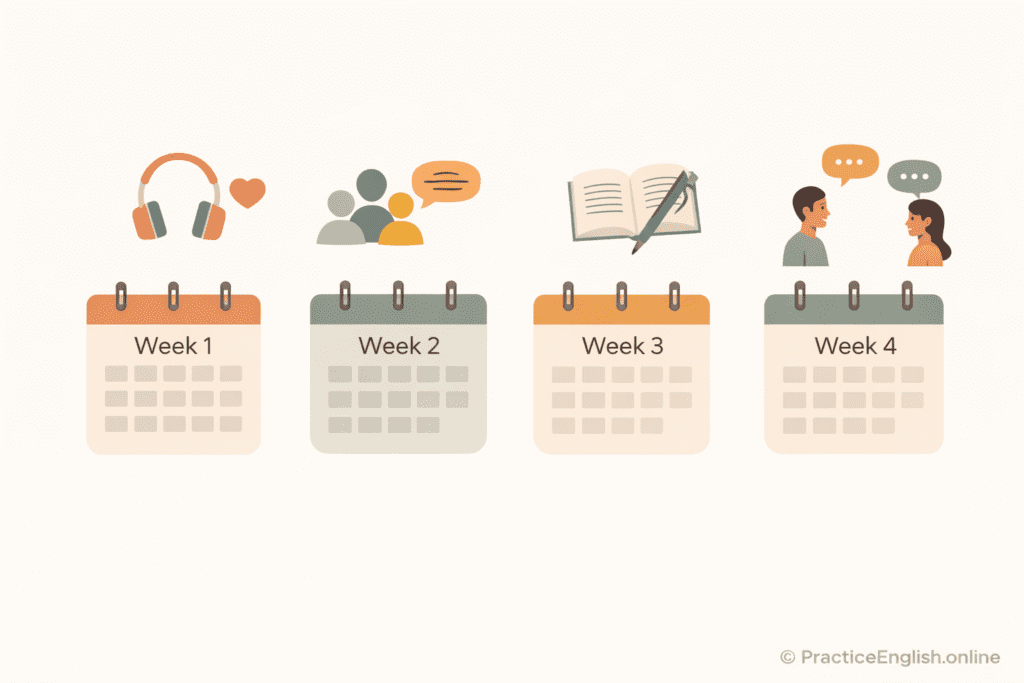
Your 30-Day Fear-Reduction Action Plan
Here’s a structured plan to start reducing your fear TODAY:
Week 1: Foundation Building
- Day 1-2: Identify your specific fears (write them down)
- Day 3-4: Practice breathing techniques daily
- Day 5-7: Speak English alone for 10 minutes daily (describe your day)
Week 2: Safe Practice
- Day 8-10: Find one safe practice partner (friend/family)
- Day 11-14: Have 15-minute English conversations with your partner
Week 3: Gradual Exposure
- Day 15-17: Speak English in one low-stakes situation daily (shop, restaurant)
- Day 18-21: Join an online English practice group or book a session with a coach
Week 4: Building Confidence
- Day 22-24: Practice one presentation or speech (even if it’s just 2 minutes)
- Day 25-27: Speak in a slightly uncomfortable situation (ask a stranger for directions)
- Day 28-30: Reflect on progress and plan next steps
Track Your Progress: Rate your fear level (1-10) before and after each practice session. Watch it decrease over time.
Success Stories: Real Indians Who Overcame This Fear
Vikram (26, Software Engineer, Pune): “I couldn’t speak in team meetings. I’d type my updates in the chat instead. After 3 months of practice with PracticeEnglish.Online, I now lead weekly standup meetings. The fear isn’t completely gone, but it’s manageable.”
Deepika (24, MBA Student, Bangalore): “I almost didn’t go to my campus placement interviews because of English fear. But I practiced with role-plays and mock interviews. I got placed in my dream company! The interviewer later told me my English was ‘perfectly fine.’ All that fear was in my head.”
Arjun (32, Manager, Delhi): “I was passed over for promotion twice because I couldn’t present well in English. I worked with a coach, practiced breathing techniques, and prepared thoroughly. Last month, I led my first client presentation in English. It wasn’t perfect, but it was successful.”
Common Questions About Fear of Speaking English
Q: How long does it take to overcome this fear? A: It varies, but most people see significant improvement in 6-8 weeks of consistent practice. Complete confidence may take 3-6 months.
Q: Will the fear ever go away completely? A: For most people, the fear reduces to manageable levels. You might still feel some nervousness (which is normal), but it won’t paralyze you.
Q: What if I freeze during an important conversation? A: Take a breath. Say “Give me a moment to gather my thoughts.” Then continue. Pauses are normal and often make you seem more thoughtful.
Q: Should I tell people I’m nervous about speaking English? A: In informal settings, yes—it reduces pressure. In professional settings, focus on doing your best rather than announcing your nervousness.
Q: Is medication or therapy needed for this fear? A: For most people, no. Consistent practice and the techniques in this article are enough. If your fear is severely debilitating, consider speaking to a counselor.
How PracticeEnglish.Online Helps You Overcome This Fear
At PracticeEnglish.Online, we don’t just teach English—we specifically help you overcome speaking anxiety.
Our Approach: ✅ Safe, Non-Judgmental Environment – Make mistakes freely without embarrassment
✅ Indian Coaches – Who understand your specific challenges and cultural context
✅ Gradual Exposure – We don’t throw you in the deep end; we build confidence step-by-step
✅ Practical Scenarios – Practice actual situations you’ll face (interviews, meetings, presentations)
✅ Personalized Feedback – Targeted advice for YOUR specific fears and challenges
✅ Flexible Online Sessions – Practice from the comfort of your home
✅ Affordable Pricing – Quality coaching designed for Indian budgets
What Our Students Say:
“I was terrified of speaking English. Now I handle client calls confidently. The supportive environment made all the difference.” – Kavita, Chennai
“They didn’t just teach me English; they taught me how to manage my fear. That was the game-changer.” – Rohan, Mumbai
Your Next Steps: Start Your Fear-Free Journey Today
You’ve read about the causes. You’ve learned the solutions. Now it’s time to take action.
Start Small:
- Practice the breathing technique right now
- Speak English to yourself for 5 minutes today
- Identify one situation this week where you’ll practice
Get Support: Don’t fight this fear alone. Having a coach accelerates progress by months.
Ready to overcome your fear and speak English confidently?
📱 WhatsApp us: +919429690114
🌐 Visit: PracticeEnglish.Online
📚 Free Resources: Download conversation guides and practice materials from our Learning Centre
Book your first FREE practice session and experience what it feels like to speak English in a completely supportive, judgment-free environment.
The Bottom Line
Your fear of speaking English is real, valid, and completely conquerable.
It’s not a character flaw. It’s not permanent. It’s not a sign that you’re “bad at English.”
It’s simply your brain trying to protect you from perceived danger—based on past experiences, cultural pressure, and lack of practice in safe environments.
With the right strategies, consistent practice, and supportive guidance, thousands of Indians have overcome this exact fear.
You can too.
The question is not “Can I overcome this?”
The question is “When will I start?”
Your confident, fluent, fear-free English-speaking self is waiting on the other side of consistent practice and courage.
Let’s make it happen—together.
Take Action Now: The fear doesn’t disappear by reading about it. It disappears by facing it in small, manageable steps with support. Book your free session today and take the first step toward fearless English speaking.
Share Your Story: Have you experienced fear of speaking English? What helped you? Share in the comments below—your experience might help someone else!