
Present Continuous Tense – Rules, Uses & Examples
What is the Present Continuous Tense?
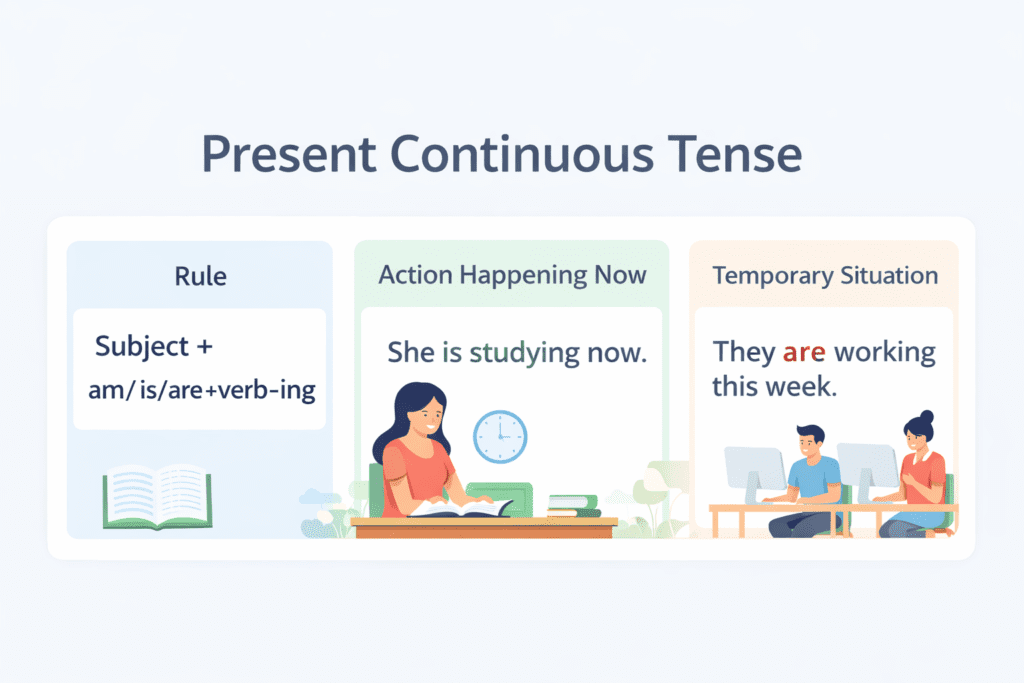
The Present Continuous Tense (also called the Present Progressive Tense) is used to talk about actions that are happening right now, temporary situations, or planned actions in the near future.
This tense helps us describe what is going on at the moment of speaking or what is happening around the present time.
Structure of the Present Continuous Tense
The basic structure is:
Subject + am / is / are + verb + ing
Examples:
I am learning English.
She is watching TV.
They are playing cricket.
Helping Verbs Used
| Subject | Helping Verb |
|---|---|
| I | am |
| He / She / It | is |
| You / We / They | are |
How to Form “-ing” Verbs
Most verbs simply add -ing:
play → playing
read → reading
Some spelling changes:
make → making (drop e)
run → running (double consonant)
lie → lying (change ie to y)
Uses of the Present Continuous Tense
1. Actions Happening Right Now
Use this tense for actions taking place at the moment of speaking.
Examples:
I am writing this lesson now.
She is talking on the phone.
They are studying English.
Keywords often used:
now, right now, at the moment
2. Temporary Actions or Situations
Use it for actions that are temporary, not permanent.
Examples:
I am staying with my friend this week.
He is working on a new project.
She is learning driving these days.
3. Future Plans (Near Future)
The present continuous tense is often used to talk about fixed plans in the near future.
Examples:
I am meeting my teacher tomorrow.
We are traveling to Delhi next week.
She is starting a new job on Monday.
4. Repeated Actions (With “Always”)
Sometimes it shows annoying or repeated actions, usually with always.
Examples:
He is always coming late.
She is always complaining.
This use often shows irritation.
Sentence Forms
Affirmative Sentences
Subject + am / is / are + verb-ing
Examples:
I am reading a book.
They are watching a movie.
Negative Sentences
Subject + am / is / are + not + verb-ing
Examples:
I am not working today.
She is not feeling well.
We are not going outside.
Short forms:
is not → isn’t
are not → aren’t
Interrogative Sentences (Questions)
Am / Is / Are + subject + verb-ing?
Examples:
Are you studying English?
Is she cooking dinner?
Am I speaking too fast?
Wh-Questions
Wh-word + am / is / are + subject + verb-ing?
Examples:
What are you doing?
Why is he shouting?
Where are they going?
Common Mistakes to Avoid
❌ I am knowing English.
✅ I am learning English.
❌ She is understanding the lesson.
✅ She understands the lesson.
👉 Some verbs (know, understand, like, love, believe) are state verbs and are usually not used in continuous form.
Present Continuous vs Present Simple
| Present Simple | Present Continuous |
|---|---|
| Daily habits | Actions happening now |
| Permanent | Temporary |
| “I work daily” | “I am working now” |
More Examples for Practice
He is preparing for his exam.
We are waiting for the bus.
The children are playing outside.
I am improving my English skills.
Quick Summary
Used for actions happening now
Used for temporary situations
Used for near future plans
Structure: am / is / are + verb-ing
Avoid using it with state verbs
✅ Tip for Learners
Try speaking sentences about what you are doing right now. This is the best way to master the present continuous tense.
📌 Next Topics (I’ll Send One by One)
Present Perfect Tense – Rules, Uses & Examples
Present Perfect Continuous Tense
Past Simple Tense
Past Continuous Tense
Past Perfect Tense
Past Perfect Continuous Tense
Future Simple (Will vs Going To)
Future Continuous Tense
Future Perfect Tense