
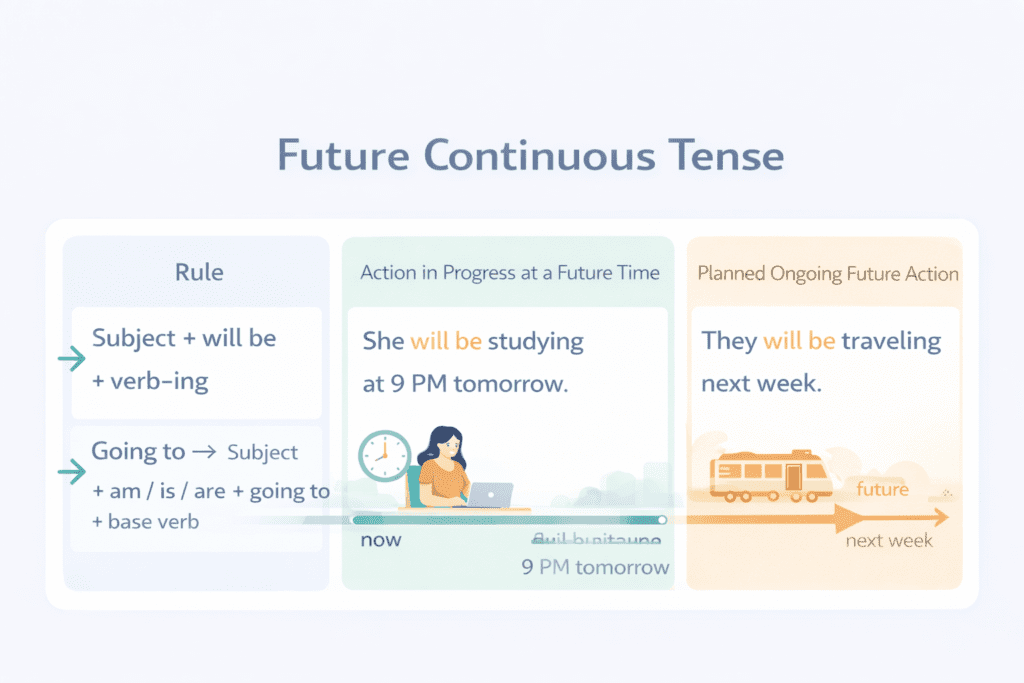
Future Continuous Tense – Rules, Uses & Examples
What is the Future Continuous Tense?
The Future Continuous Tense is used to talk about actions that will be in progress at a specific time in the future.
This tense focuses on:
An action that will be happening
A particular time in the future
The idea of continuation, not completion
In simple words, it describes what will be going on at a future moment.
Structure of the Future Continuous Tense
The basic structure is:
Subject + will be + verb-ing
Examples:
I will be studying English tonight.
She will be working at 10 AM tomorrow.
They will be traveling next week.
👉 “Will be” is used for all subjects.
Uses of the Future Continuous Tense
1. Action in Progress at a Specific Time in the Future
This is the most common use of the future continuous tense.
Use it when you want to say what will be happening at a particular future time.
Examples:
I will be sleeping at 11 PM.
She will be attending a meeting tomorrow morning.
They will be watching the match at 7 PM.
Common time expressions:
at 8 PM tomorrow, this time tomorrow, next week, in the evening
2. Planned or Expected Future Actions
Use this tense to talk about actions that are expected or part of a routine in the future.
Examples:
I will be working from home next week.
She will be teaching English this month.
We will be staying at a hotel during the trip.
3. Polite Questions About Future Plans
The future continuous tense is often used to ask polite questions, especially when you don’t want to sound direct.
Examples:
Will you be using the car tomorrow?
Will she be joining the call?
Will they be staying long?
👉 This sounds more polite than “Will you use…?”
4. Actions Happening Simultaneously in the Future
Use this tense when two or more actions will be happening at the same time in the future.
Examples:
She will be cooking while he will be cleaning.
I will be studying while my brother will be playing.
They will be traveling while we will be working.
Sentence Forms
Affirmative Sentences
Subject + will be + verb-ing
Examples:
I will be learning new grammar rules.
She will be practicing speaking English.
They will be preparing for the interview.
Negative Sentences
Subject + will not be + verb-ing
Examples:
I will not be attending the class tomorrow.
She will not be working this weekend.
They will not be traveling next month.
Short form:
will not → won’t
Interrogative Sentences (Questions)
Will + subject + be + verb-ing?
Examples:
Will you be studying tonight?
Will she be coming to the party?
Will they be waiting for us?
Wh-Questions
Wh-word + will + subject + be + verb-ing?
Examples:
What will you be doing tomorrow?
Where will she be working next year?
Why will they be leaving early?
Common Time Expressions Used
this time tomorrow
at 10 AM tomorrow
next week
in the evening
tonight
Examples:
I will be studying this time tomorrow.
She will be attending a workshop next week.
They will be traveling in the evening.
Common Mistakes to Avoid
❌ I will studying tomorrow.
✅ I will be studying tomorrow.
❌ She will be study at night.
✅ She will be studying at night.
❌ Will you be study English?
✅ Will you be studying English?
Future Simple vs Future Continuous
| Future Simple | Future Continuous |
|---|---|
| Action happens | Action in progress |
| “I will study” | “I will be studying” |
| Focus on result | Focus on duration |
Example Comparison:
I will study at night. (decision/action)
I will be studying at 9 PM. (action in progress)
More Examples for Practice
I will be improving my pronunciation.
She will be attending English classes.
We will be discussing grammar rules.
They will be practicing spoken English daily.
Quick Summary
Used for actions in progress in the future
Structure: will be + verb-ing
Often used with specific future times
Sounds polite and natural in questions
✅ Tip for Learners
When you want to say what will be happening at a particular time in the future, use the future continuous tense.