
Subject and Predicate – Definition, Rules & Examples
What Are Subject and Predicate in English?
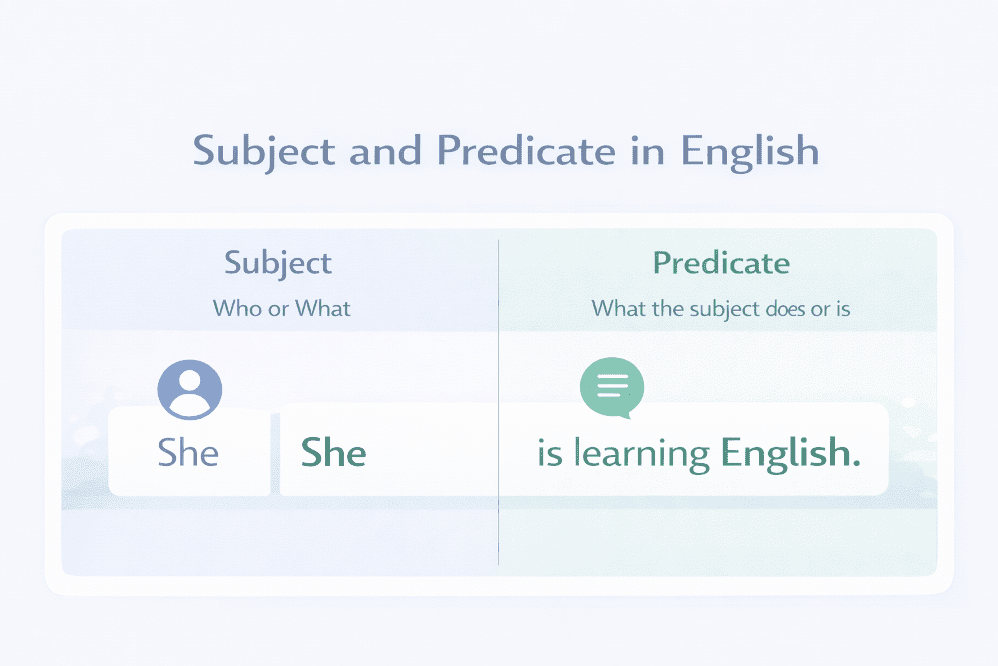
Every complete sentence in English has two main parts:
Subject
Predicate
These two parts work together to make meaning.
If either one is missing, the sentence is incomplete.
Understanding subject and predicate helps learners:
Form correct sentences
Avoid common grammar mistakes
Improve spoken and written English
What is a Subject?
The subject of a sentence tells us:
Who is doing the action, or
What the sentence is about
In simple words, the subject answers:
Who? or What?
Examples of Subjects
She is learning English.
The teacher explained the lesson.
English grammar is important.
They are practicing daily.
👉 The highlighted words are the subjects.
What is a Predicate?
The predicate is the part of the sentence that:
Tells us what the subject does
Describes the action or state of the subject
In simple words, the predicate tells us:
What is happening?
Examples of Predicates
She is learning English.
The teacher explained the lesson.
English grammar is important.
They are practicing daily.
👉 The highlighted parts are the predicates.
Structure of a Sentence
A basic English sentence follows this structure:
Subject + Predicate
Examples:
I | am learning English.
She | works in an office.
They | are watching a movie.
Types of Subjects
1. Simple Subject
The simple subject is the main word (noun or pronoun) in the subject.
Examples:
She is learning English.
Students are attending class.
Dog is barking.
2. Complete Subject
The complete subject includes:
The main subject
All the words that describe it
Examples:
The young girl is learning English.
My best friend lives in Mumbai.
Those hardworking students passed the exam.
👉
Simple subject: girl, friend, students
Complete subject: The young girl, My best friend, Those hardworking students
Types of Predicates
1. Simple Predicate
The simple predicate is the main verb or verb phrase.
Examples:
She is learning English.
He plays cricket.
They are studying grammar.
2. Complete Predicate
The complete predicate includes:
The verb
All words that give more information about the verb
Examples:
She is learning English every day.
He plays cricket in the evening.
They are studying grammar for exams.
Subject and Predicate in Different Sentence Types
Declarative Sentence
She | is practicing English.
The class | starts at 9 AM.
Interrogative Sentence
In questions, the subject often comes after the verb, but it still exists.
Are you learning English?
Did she complete the lesson?
👉 Subject = you, she
Imperative Sentence
In imperative sentences, the subject is not written, but it is understood as “you.”
(You) Close the door.
(You) Please listen carefully.
Exclamatory Sentence
What a beautiful place this is!
Subject: this
Predicate: is a beautiful place
How to Identify Subject and Predicate
Step 1: Find the Verb
The verb is always in the predicate.
Step 2: Ask “Who?” or “What?”
The answer is the subject.
Example:
Sentence: She is learning English.
Verb: is learning
Who is learning? → She (Subject)
Predicate: is learning English
Common Mistakes to Avoid
❌ Is learning English very important.
✅ Learning English is very important.
❌ She learning English.
✅ She is learning English.
❌ Running in the park is fun.
✅ ✅ (Correct – Subject = Running in the park)
More Practice Examples
Identify the subject and predicate:
My brother | is preparing for exams.
English grammar | helps improve communication.
They | have completed the lesson.
The online class | was very helpful.
Why Subject and Predicate Are Important
Every sentence needs them
Helps avoid incomplete sentences
Improves sentence formation
Builds confidence in speaking and writing
Quick Summary
Every sentence has a subject and a predicate
Subject = who or what
Predicate = what the subject does or is
Subjects and predicates can be simple or complete
Even questions and commands have subjects
✅ Tip for Learners
If a sentence feels incomplete, check:
Does it have both a subject and a predicate?
If yes — your sentence is correct.