
Simple, Compound & Complex Sentences – Definition, Rules & Examples
What Are Sentence Structures in English?
In English grammar, sentences are not only classified by purpose (statement, question, command, exclamation) but also by structure.
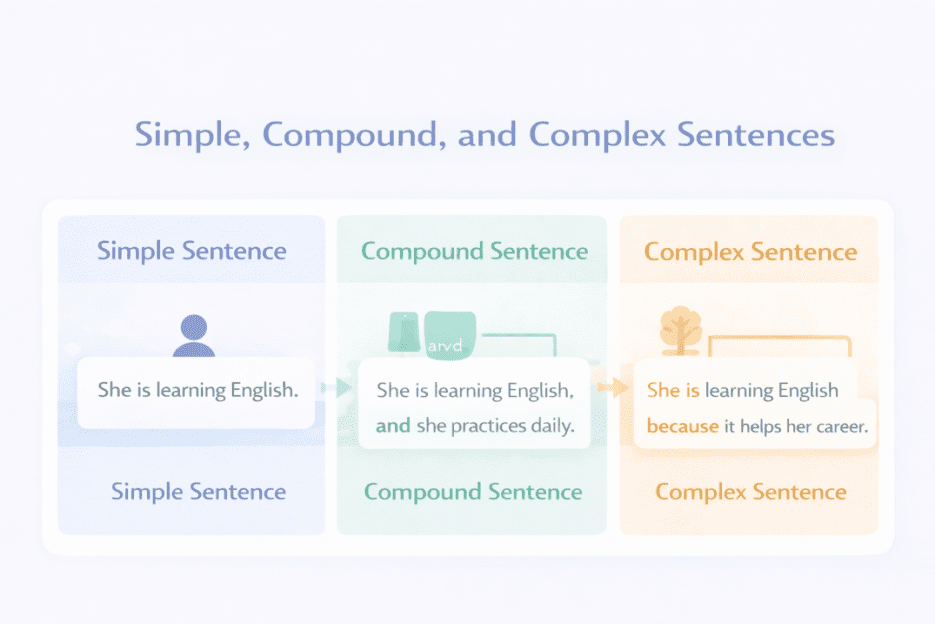
Based on structure, sentences are divided into three main types:
Simple Sentences
Compound Sentences
Complex Sentences
Understanding these sentence types helps learners:
Write longer and clearer sentences
Avoid repetition
Improve spoken and written English
Sound more natural and confident
1. Simple Sentences
What is a Simple Sentence?
A simple sentence has:
One subject
One predicate
One independent clause
Even if the sentence is long, it is still simple if it has only one main clause.
Structure of a Simple Sentence
Subject + Verb (+ Object / Complement)
Examples of Simple Sentences
I am learning English.
She works in an office.
They are practicing grammar every day.
My brother plays cricket in the evening.
Important Points About Simple Sentences
They express one complete idea
They are clear and easy to understand
They are very common in spoken English
Common Mistakes
❌ I learning English.
✅ I am learning English.
❌ She working hard.
✅ She is working hard.
2. Compound Sentences
What is a Compound Sentence?
A compound sentence is made by joining two or more independent clauses.
Each clause can stand alone as a simple sentence, but they are connected using:
Coordinating conjunctions
Or a semicolon (;)
Coordinating Conjunctions (FANBOYS)
For
And
Nor
But
Or
Yet
So
Structure of a Compound Sentence
Independent clause + conjunction + independent clause
Examples of Compound Sentences
I am learning English, and she is learning Spanish.
He was tired, but he continued studying.
You can practice speaking, or you can practice writing.
She studied hard, so she passed the exam.
Compound Sentence with Semicolon
I like English grammar; I practice it daily.
He was late; the class had already started.
Common Mistakes
❌ I am learning English and practicing daily. (not compound)
✅ I am learning English, and I practice daily.
❌ She was tired but.
✅ She was tired, but she continued working.
3. Complex Sentences
What is a Complex Sentence?
A complex sentence has:
One independent clause
One or more dependent (subordinate) clauses
The dependent clause cannot stand alone and depends on the main clause for meaning.
Structure of a Complex Sentence
Independent clause + dependent clause
or
Dependent clause + independent clause
Common Subordinating Conjunctions
because
although
when
while
if
since
before
after
that
Examples of Complex Sentences
I am learning English because it is important.
She continued studying although she was tired.
When the class ended, we asked questions.
He stayed home because it was raining.
Comma Rule
If the sentence starts with a dependent clause, use a comma.
✅ When the class ended, we left.
❌ When the class ended we left.
Simple vs Compound vs Complex (Comparison Table)
| Sentence Type | Clauses | Example |
|---|---|---|
| Simple | 1 independent | I am learning English. |
| Compound | 2+ independent | I am learning English, and she is teaching me. |
| Complex | 1 independent + 1 dependent | I am learning English because it helps my career. |
Why These Sentence Types Matter
Help you combine ideas
Improve writing quality
Make speech more fluent
Avoid repeating short sentences
Common Mistakes to Avoid
❌ Because I was tired. (incomplete)
✅ I went to bed because I was tired.
❌ I studied hard I passed the exam.
✅ I studied hard, so I passed the exam.
❌ Although she was tired she worked.
✅ Although she was tired, she worked.
Practice Examples
Identify the sentence type:
She is learning English. → Simple
He practiced daily, so he improved. → Compound
I stayed home because it was raining. → Complex
They studied hard, but they were nervous. → Compound
Quick Summary
Simple sentence → one main idea
Compound sentence → two equal ideas joined
Complex sentence → one main idea + extra information
Each type improves communication when used correctly
✅ Tip for Learners
Start with simple sentences, then slowly combine them into compound and complex sentences to sound more fluent and confident.