
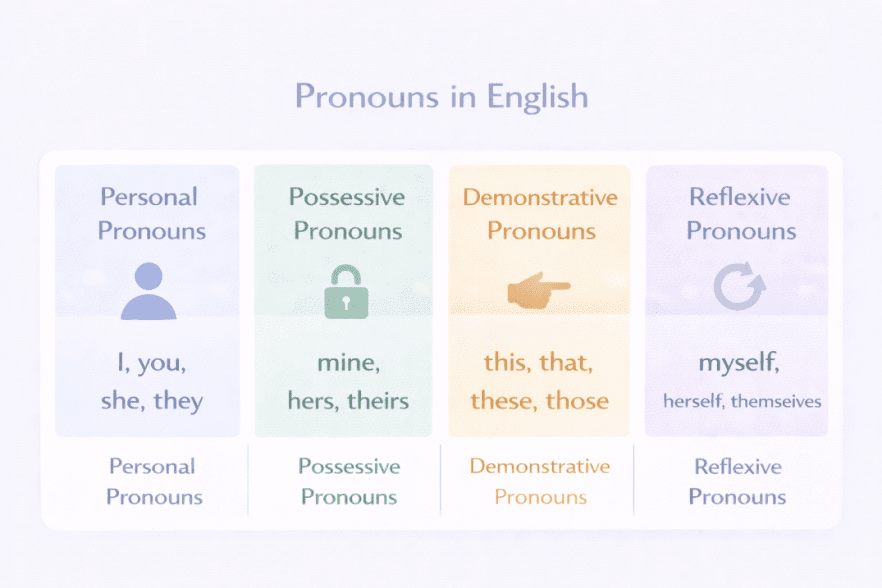
Pronouns – Types, Rules & Examples
What is a Pronoun?
A pronoun is a word that is used instead of a noun.
Pronouns help us:
Avoid repeating the same noun again and again
Make sentences smoother and clearer
Sound natural in spoken and written English
Example
❌ Riya is learning English. Riya practices every day.
✅ Riya is learning English. She practices every day.
Here, “she” is a pronoun used instead of Riya.
Common Examples of Pronouns
I, you, he, she, it, we, they
me, him, her, us, them
this, that, these, those
Types of Pronouns in English
There are several types of pronouns, each used for a specific purpose.
Let’s understand them one by one with simple explanations and examples.
1. Personal Pronouns
What are Personal Pronouns?
Personal pronouns are used to refer to:
A person
An animal
A thing
They change based on:
Person (first, second, third)
Number (singular or plural)
Case (subject or object)
Subject Pronouns
| Pronoun | Used As |
|---|---|
| I | speaker |
| you | listener |
| he / she / it | third person |
| we | group including speaker |
| they | others |
Examples:
I am learning English.
She practices daily.
They are attending class.
Object Pronouns
me, you, him, her, it, us, them
Examples:
She helped me.
I called him.
The teacher guided them.
2. Possessive Pronouns
What are Possessive Pronouns?
Possessive pronouns show ownership or possession.
Examples of Possessive Pronouns
mine, yours, his, hers, its, ours, theirs
Examples:
This book is mine.
That bag is hers.
The decision is theirs.
Possessive Adjectives (Related Words)
my, your, his, her, its, our, their
Examples:
This is my book.
She lost her phone.
They completed their work.
3. Reflexive Pronouns
What are Reflexive Pronouns?
Reflexive pronouns are used when the subject and object are the same.
Examples of Reflexive Pronouns
myself, yourself, himself, herself, itself, ourselves, themselves
Examples:
I taught myself English.
She hurt herself.
They enjoyed themselves at the party.
4. Demonstrative Pronouns
What are Demonstrative Pronouns?
Demonstrative pronouns are used to point to specific things.
Examples
| Pronoun | Usage |
|---|---|
| this | near (singular) |
| that | far (singular) |
| these | near (plural) |
| those | far (plural) |
Examples:
This is my notebook.
That is your bag.
These are my notes.
Those are old books.
5. Relative Pronouns
What are Relative Pronouns?
Relative pronouns are used to join two sentences and give more information about a noun.
Common Relative Pronouns
who, whom, whose, which, that
Examples
She is the student who practices daily.
This is the book that I like.
He met a teacher who helped him.
6. Interrogative Pronouns
What are Interrogative Pronouns?
Interrogative pronouns are used to ask questions.
Examples
who, whom, whose, what, which
Examples:
Who is learning English?
What is your name?
Which book do you prefer?
7. Indefinite Pronouns
What are Indefinite Pronouns?
Indefinite pronouns refer to people or things in a general way, not specific ones.
Examples of Indefinite Pronouns
someone, anyone, everyone
something, anything, nothing
many, few, several, all
Examples:
Someone is waiting outside.
Everyone enjoyed the class.
Nothing is impossible.
8. Reciprocal Pronouns
What are Reciprocal Pronouns?
Reciprocal pronouns show mutual action between two or more people.
Examples
each other, one another
Examples:
They help each other.
The students respect one another.
Common Pronoun Mistakes to Avoid
❌ Her is my friend.
✅ She is my friend.
❌ This book is her.
✅ This book is hers.
❌ Everyone forgot their book.
✅ Everyone forgot his or her book.
(Modern usage: their is also acceptable in informal English.)
Pronouns in a Sentence (Example)
Sentence:
She gave me her book because I forgot mine.
| Word | Type |
|---|---|
| She | Personal |
| me | Object |
| her | Possessive adjective |
| I | Personal |
| mine | Possessive pronoun |
Why Pronouns Are Important
Avoid repetition
Make communication smooth
Improve fluency
Essential for correct grammar
Quick Summary
Pronouns replace nouns
There are many types of pronouns
Each type has a specific use
Correct pronoun usage improves clarity
✅ Tip for Learners
If a sentence sounds repetitive, ask:
Can I replace this noun with a pronoun?
Most of the time, the answer is yes.