
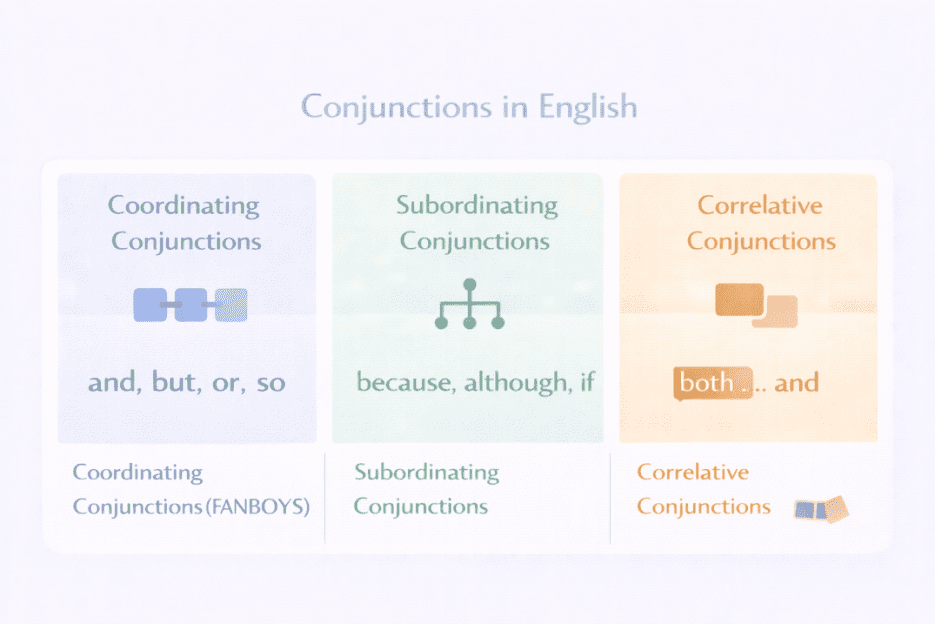
Conjunctions – Types, Rules & Examples
What is a Conjunction?
A conjunction is a word that joins:
-
words
-
phrases
-
clauses
-
sentences
Conjunctions help us:
-
Combine ideas
-
Avoid short, repetitive sentences
-
Make speech and writing smooth and logical
Examples of Conjunctions
-
and
-
but
-
or
-
because
-
although
-
so
Examples in sentences:
-
I practice daily and I improve.
-
She was tired but she continued.
-
He stayed home because it was raining.
Why Conjunctions Are Important
Conjunctions help us:
-
Show addition, contrast, choice, reason, result
-
Express ideas clearly
-
Build longer, meaningful sentences
Compare:
-
❌ I was tired. I continued studying.
-
✅ I was tired, but I continued studying.
Types of Conjunctions in English
Conjunctions are mainly divided into three types:
-
Coordinating Conjunctions
-
Subordinating Conjunctions
-
Correlative Conjunctions
Let’s understand each type clearly.
1. Coordinating Conjunctions
What are Coordinating Conjunctions?
They join:
-
two words
-
two phrases
-
two independent clauses (equal importance)
FANBOYS (Easy to Remember)
-
For
-
And
-
Nor
-
But
-
Or
-
Yet
-
So
Uses with Examples
-
And → addition
-
She studies and practices daily.
-
-
But → contrast
-
He is tired, but he is studying.
-
-
Or → choice
-
You can call or message me.
-
-
So → result
-
She studied hard, so she passed.
-
-
Yet → unexpected contrast
-
He is poor, yet he is happy.
-
Comma Rule
When joining two independent clauses, use a comma before the conjunction.
✅ I was tired, but I continued.
❌ I was tired but I continued.
2. Subordinating Conjunctions
What are Subordinating Conjunctions?
They join:
-
one independent clause
-
one dependent clause
They show relationships like:
-
reason
-
time
-
condition
-
contrast
Common Subordinating Conjunctions
because, although, when, while, if, since, before, after, unless
Examples in Sentences
-
I stayed home because it was raining.
-
Although she was tired, she studied.
-
Call me when you arrive.
-
You will succeed if you practice daily.
Comma Rule (Important)
If the sentence starts with the dependent clause, use a comma.
✅ When the class ended, we left.
❌ When the class ended we left.
3. Correlative Conjunctions
What are Correlative Conjunctions?
They are pairs of conjunctions that work together.
Common Correlative Conjunctions
-
both … and
-
either … or
-
neither … nor
-
not only … but also
-
whether … or
Examples in Sentences
-
Both English and Hindi are useful.
-
Either you call me or send a message.
-
Neither he nor she was present.
-
She is not only smart but also hardworking.
Conjunction vs Preposition (Common Confusion)
| Conjunction | Preposition |
|---|---|
| Joins clauses | Followed by noun/pronoun |
| because | because of |
| although | despite |
Examples:
-
I stayed home because it was raining. (conjunction)
-
I stayed home because of rain. (preposition)
Common Conjunction Mistakes to Avoid
❌ Although she was tired but she studied.
✅ Although she was tired, she studied.
❌ He is poor and he is honest. (okay but repetitive)
✅ He is poor but honest.
❌ Because I was late.
✅ I was late because I missed the bus.
Practice Examples
Choose the correct conjunction:
-
I was tired ___ I continued studying. (but)
-
She stayed home ___ it was raining. (because)
-
You can tea ___ coffee. (or)
-
___ you practice, you will improve. (If)
Why Learning Conjunctions Is Important
-
Helps connect ideas smoothly
-
Improves sentence structure
-
Makes writing more fluent
-
Essential for complex sentences
Quick Summary
-
Conjunctions join words, phrases, and clauses
-
There are three main types
-
FANBOYS help remember coordinating conjunctions
-
Correct usage improves clarity and fluency
✅ Tip for Learners
When joining two ideas, ask:
Are both ideas equal, or is one dependent on the other?
That will help you choose the right conjunction.