
How to Learn Spoken English with Movies: The Complete System
You have been watching English movies for months. Your speaking still hasn’t improved. This guide shows you exactly why — and how to fix it with a structured, proven system built for Indian learners.
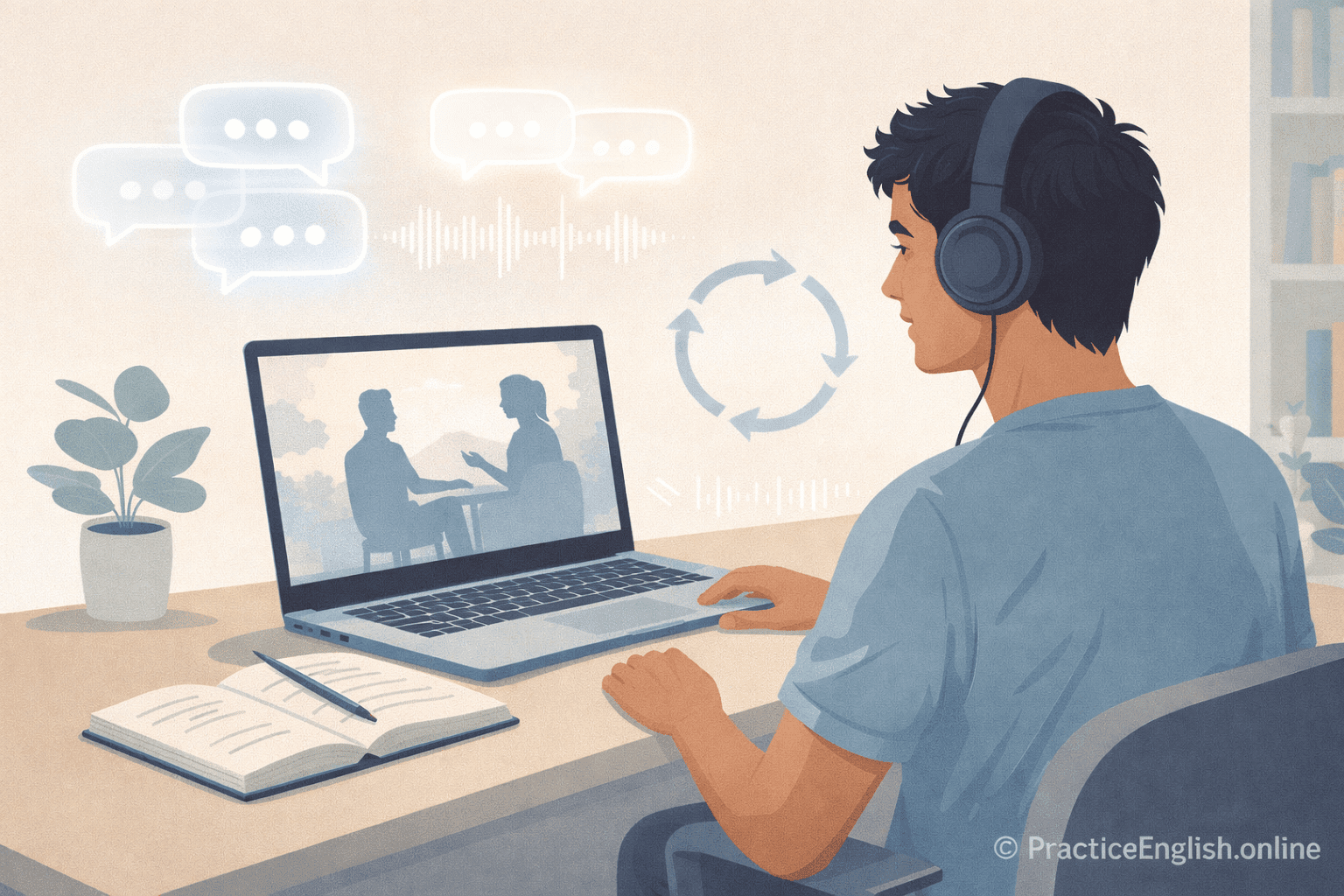
You have probably done this before. You open Netflix, pick an English movie, turn on subtitles, and watch for two hours. It feels productive. It feels like studying. And yet, weeks later, you still hesitate the moment someone asks you to speak in English.
You are not alone. Millions of Indian learners watch English content every single day, but very few actually become fluent speakers from it. If you want to learn spoken English with movies, watching alone is never enough. Fluency is built through structured, deliberate practice — and this guide gives you exactly that system.
How to Learn Spoken English with Movies
To learn spoken English with movies, use the 3-Stage Viewing Method: watch without subtitles, rewatch with English subtitles, then watch again without. Follow each session with shadowing, phrase collection, and 5 minutes of speaking practice. Consistency over 4–6 weeks produces measurable improvement in fluency and confidence.
- Why Passive Watching Does Not Build Fluency
- Why Movies Are Powerful Tools for Spoken English
- Step 1: Choose the Right Kind of Movie
- Step 2: The 3-Stage Viewing Method
- Step 3: Master the Movie Shadowing Technique
- Step 4: Build Your Movie Expression Notebook
- Step 5: Convert Listening into Speaking Practice
- Common Mistakes Indian Learners Make
- How Movie Practice Helps You Stop Hesitating
- Daily 30-Minute Practice Plan
- How Long Before You See Real Improvement
- Frequently Asked Questions
- Final Thoughts
Why Passive Watching Does Not Build Fluency
The gap between understanding English and speaking it confidently is one of the most frustrating experiences for Indian learners. You watch English content, you follow the story, you even laugh at the jokes — but when it is time to speak, the words do not come. Here is why:
- Your brain processes the language as entertainment, not as training material
- You rely on Hindi subtitles, which keeps you mentally translating rather than thinking in English
- You never reproduce the language — you only receive it
- Native speakers talk at full speed with reductions and contractions that textbooks never teach
- There is no repetition, no feedback, and no speaking practice attached to the viewing
The solution is not to stop watching movies. The solution is to watch them differently.
Why Movies Are Powerful Tools for Spoken English Practice
When used correctly, movies offer something no textbook or classroom can fully replicate: natural, real-world English in context. Every scene is a live demonstration of how native speakers actually communicate. Movies expose you to:
- Natural pronunciation, including connected speech and word reductions
- Real conversational rhythm and sentence stress
- Informal vocabulary, idioms, and expressions used in everyday life
- Tone, emotion, and body language attached to language
- A wide range of accents and speaking styles
But exposure alone is only the first step. What separates learners who improve from those who plateau is what they do after they watch.
Step 1: Choose the Right Kind of Movie to Learn English
Not every English movie is equally effective for language learning. Your goal at the start is to maximise clarity and conversational density — not cinematography or complex storytelling.
Best Movie Types for Indian English Learners
- Modern conversational dramas — films set in everyday environments like offices, homes, and schools
- Romantic comedies with natural dialogue between characters
- Workplace and family-based stories where characters talk about real, relatable situations
- Slice-of-life films with moderate pacing and clear dialogue
Movies to Avoid When You Are Starting Out
- Fast-paced action films with minimal conversation
- Movies with heavy regional slang or period-specific dialogue
- Complex historical dramas or old British classics with archaic language
- Fantasy films with invented vocabulary
If you catch at least 50–60% of the conversation without subtitles, the movie is at the right level for active practice. If you understand less than that, it is too advanced to shadow effectively — choose something simpler first.
Step 2: The 3-Stage Viewing Method
This is the most important part of learning spoken English with movies. Most learners either watch once and move on, or watch passively with subtitles the whole time. The 3-Stage Viewing Method changes that completely.
Watch Without Subtitles
Your first viewing should be entirely without subtitles. Do not pause. Do not look up words. Focus on understanding the main idea of the scene, feeling the emotional tone, and noticing patterns — even if you miss specific words. This trains your listening tolerance and teaches your brain to handle natural speech speed without panicking.
Watch With English Subtitles Only
Now watch the same content again with English subtitles — never Hindi. Pay close attention to the gap between how words are written and how they are actually spoken. You will notice reductions like:
These are not mistakes — they are how real English sounds. Understanding this is a major breakthrough for most Indian learners.
Watch Again Without Subtitles
Watch the same content one more time — no subtitles. Your comprehension will be noticeably higher. Your brain now connects the spoken sounds to the written words from Stage 2. This repetition is where real learning happens — you are training your auditory memory and building a foundation for natural English speech.
Step 3: Master the Movie Shadowing Technique
If there is one practice that separates fluent speakers from those who are still stuck, it is shadowing. This technique is used by language learners, professional interpreters, and public speakers all over the world.
Select & Listen
Pick a 30–60 second clip. Listen to a single sentence carefully — focus on rhythm, stress, and emotion.
Pause
Pause immediately after the sentence ends. Give yourself a moment before repeating.
Repeat Everything
Repeat out loud — not just the words, but the speed, rhythm, stress, intonation, and emotion of the speaker.
For example, if the movie line is “I don’t think that’s a good idea” — do not just say the words flatly. Notice where the speaker places emphasis. Listen to how the words run together. Match the cadence exactly.
Shadowing consistently improves your pronunciation, speaking rhythm, and confidence. When you practise this regularly, your mouth and brain start to work together in English — instead of constantly translating from Hindi or your mother tongue. You can read more about the research behind the shadowing technique and why it works so effectively.
Step 4: Build Your Movie Expression Notebook
Stop collecting individual words. Start collecting useful spoken phrases. Every movie is packed with natural conversational expressions you can immediately use in real conversations. As you watch, note down phrases like these:
After writing them down, set a goal to use at least two new movie phrases every day — whether in conversation, in writing, or practising aloud. Phrases used repeatedly move from your passive vocabulary into your active vocabulary, where they become available to you instantly in real speech.
Step 5: Convert Listening into Speaking Practice
This is the step that most learners skip entirely — and it is the most important one. Fluency requires output. You cannot build speaking skills by only receiving language. You must produce it. After watching a scene, try these speaking exercises:
- Retell what happened in the scene in your own words — without looking at the screen
- Describe the characters and their emotions
- Give your personal opinion about what you just watched
- Predict what will happen next in the story
- Record yourself summarising the scene and listen back critically
These exercises force your brain into production mode. They activate the vocabulary and sentence structures you absorbed while watching — and push you to organise your thoughts in English. This is where passive exposure turns into active fluency. If you are also working on how to stop hesitating while speaking English, this speaking step directly addresses that habit.
Common Mistakes Indian Learners Make When Learning English with Movies
Understanding what not to do is just as important as knowing what to do. Here are the most common mistakes that prevent Indian learners from improving their spoken English through movies:
Watching with Hindi subtitles — this keeps your brain in translation mode and prevents you from thinking in English.
Watching without repetition — watching a movie once, no matter how carefully, is not enough. Repetition is where learning is cemented.
Trying to copy the accent immediately — focus on clarity and natural rhythm first. Accent develops naturally with consistent practice over time.
Choosing movies that are too advanced — if you cannot follow even 50% of the conversation, the content is too difficult for active practice right now.
Focusing only on vocabulary — single words are far less useful than complete phrases. Learn how words are used together, not just what they mean.
Never speaking after watching — this is the biggest mistake of all. Every session must end with speaking practice, without exception.
How Movie-Based Practice Helps You Stop Hesitating in English
One of the biggest challenges for Indian English speakers is hesitation. You know what you want to say, but you freeze before the words come out. This happens for three main reasons:
Your brain is still translating from your native language before speaking
You are overthinking grammar and word choice in real time during the conversation
You have not heard enough natural English to feel confident forming sentences automatically
Movie shadowing directly addresses all three of these issues. When you repeatedly hear and imitate natural sentence patterns, your brain starts to recognise them automatically. Over time, you stop translating and start thinking in English. For learners preparing for professional situations, also read our guide on how to introduce yourself in English in a job interview — the same fluency principles apply directly.
A Daily 30-Minute Movie Practice Plan for Spoken English
You do not need hours of study every day. What you need is consistency. Here is a simple, effective daily practice routine:
Watch a short scene (3–5 minutes) without subtitles. Focus on overall comprehension and emotional tone.
Rewatch the same scene with English subtitles. Identify 5–10 useful phrases and note connected speech patterns.
Shadow 5–8 lines from the scene. Repeat each line three times, matching the speaker’s speed, tone, and rhythm.
Speak for 4–5 minutes about the scene — retell it, describe the characters, or give your opinion. No script. No notes.
Want Guided Practice Beyond Movies?
Movie practice builds exposure. Live sessions build fluency. At PracticeEnglish.online, you practise speaking in real conversations with a mentor and receive corrections in real time — so your improvement is faster and more consistent.
Join a Free Practice SessionHow Long Before You See Real Improvement in Spoken English?
If you follow this structured system daily, here is a realistic improvement timeline:
Your listening comprehension improves noticeably — you catch more words without subtitles.
Your pronunciation becomes cleaner — you stop saying words in isolation and start flowing between them naturally.
Your hesitation reduces significantly — sentences come more naturally without the mental translation step.
Your spoken English confidence is visibly stronger — you find yourself thinking in English during real conversations.
These results come from structured, active practice — not passive watching. The learners who see the fastest improvement are the ones who never skip the speaking practice at the end of each session.
Frequently Asked Questions
No. Streaming platforms offer excellent language input, but fluency requires more: deliberate repetition, active speaking practice, structured drills, and feedback. Think of it this way — watching a cooking show does not teach you to cook. You need to get in the kitchen and practise. Movies are your raw material. What you do with that material determines whether you improve.
No — not if your goal is spoken English fluency. Hindi subtitles keep your brain in translation mode, which reinforces the exact habit that causes hesitation. Always use English subtitles, or no subtitles at all. Your brain must stay inside English throughout the session.
Choose movies with clear, modern dialogue — conversational dramas, workplace stories, and romantic comedies work well. Avoid fast-paced action films, heavy fantasy, or period dramas with archaic language. The best content for practice is anything where you understand at least 50–60% of the conversation without subtitles, giving you enough context to shadow and build on.
The content is different, but the learning method is the same. The 3-Stage Viewing Method, shadowing, and speaking practice can all be applied to YouTube videos, TED Talks, or any English video content. In fact, YouTube educators and news presenters often have clearer speech than movie actors, making them excellent shadowing material for beginners.
Shadowing works because it forces simultaneous processing — you hear the language and immediately reproduce it at the same speed and rhythm. This trains your mouth, your ear, and your brain at the same time. Over time, common sentence patterns become automatic, which is exactly what reduces hesitation and makes speech feel natural rather than effortful.
Final Thoughts: Use Movies as a Tool, Not Entertainment
If you have been watching English movies for months or years and your speaking has not improved much, it is not because you lack ability. It is because you have been using a powerful tool in the wrong way.
Learning how to learn spoken English with movies is about shifting your mindset from passive viewer to active learner. Choose the right content. Use the 3-Stage Viewing Method. Shadow consistently. Collect real phrases. And always — always — end every session with speaking.
Start today. Pick one scene. Watch it three times. Shadow five lines. Then talk about it for five minutes. Do that every day. Fluency is not something that happens to you. It is something you build — one practice session at a time.
Movies Build Exposure. Live Practice Builds Fluency.
Join a guided spoken English session and get real-time corrections on pronunciation, clarity, and confidence — beyond what any movie can offer.
Join a Free Practice Session No exams. No certificates. Just practice and feedback.