
Common English Mistakes Hindi Speakers Make — and How to Fix Them
If Hindi is your first language, the same small errors come up again and again in spoken English. Here is exactly what they are, why they happen, and how to correct them — permanently.

If Hindi is your first language, you already have a huge advantage when learning English. Years of English education in Indian schools mean most Hindi speakers can read and write reasonably well. But when it comes to speaking, the same common English mistakes Hindi speakers make come up again and again — and they are surprisingly easy to fix once you know what they are.
This guide covers all 8 mistakes with clear examples, a wrong/right comparison for each, and a practical daily routine to fix them. If you are also working on how to stop hesitating while speaking English, fixing these structural errors will directly reduce the pauses and overthinking that cause hesitation.
Common English Mistakes Hindi Speakers Make
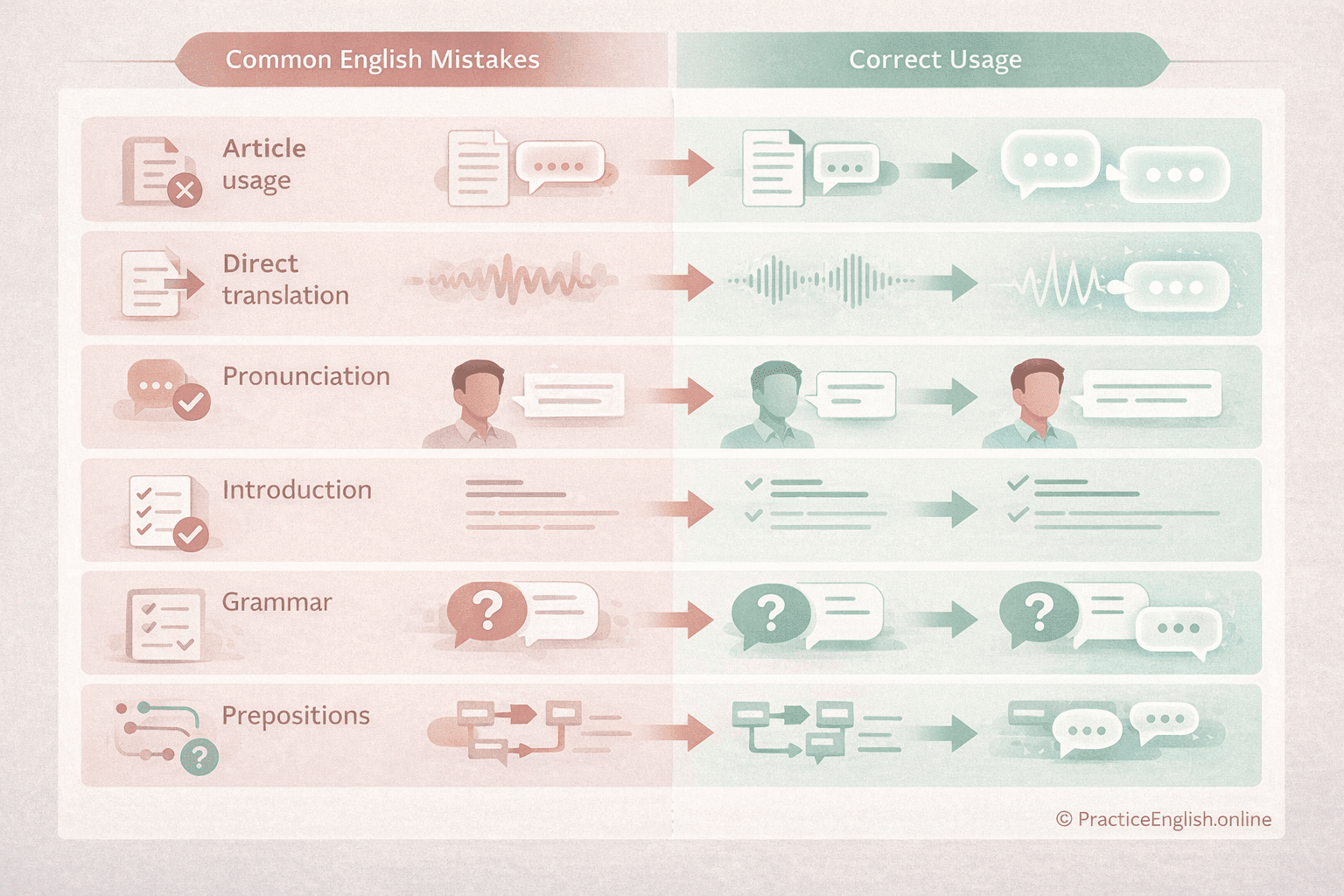
The most common English mistakes Hindi speakers make include: wrong use of articles (a, an, the), direct word-for-word translation, confusing V and W sounds, saying “Myself Rahul” as an introduction, subject-verb agreement errors, using “doubt” instead of “question”, wrong prepositions, and overusing filler words like “actually”, “basically”, and “only”.
Why Hindi Speakers Make These Specific Mistakes
Hindi and English are structurally very different languages. Hindi is a Subject-Object-Verb (SOV) language — the verb comes at the end of the sentence. English is Subject-Verb-Object (SVO) — the verb comes right after the subject. On top of this, Hindi has no articles, different rules for expressing time and action, and verb forms that do not change based on subject the way English verbs do.
Many Hindi speakers unconsciously apply Hindi grammar rules when speaking English. The result sounds slightly off — not because the speaker lacks vocabulary, but because the sentence structure reflects Hindi thinking.
The good news: once you see the pattern, fixing it becomes straightforward.
All 8 Mistakes — Explained and Fixed
Click each mistake to expand the full explanation, examples, and fix.
Wrong Use of Articles — “a”, “an”, and “the”
−Hindi has no articles at all — no equivalent of “a”, “an”, or “the”. This means Hindi speakers often drop them entirely or use the wrong one, one of the most frequent common English mistakes Hindi speakers make in both spoken and written English.
How to fix it: Use “a” or “an” the first time you mention something new. Use “the” when referring to something already known or specific. When in doubt, say the sentence aloud — if it sounds incomplete, it probably needs an article.
Direct Translation from Hindi — Word-for-Word Errors
+Many Hindi speakers translate phrases directly from Hindi into English, word by word. This produces sentences that are structured but sound unnatural or confusing to a fluent English speaker.
Phrases to stop using: “good name”, “do one thing”, “today only”, “I am having doubt”, “I am having headache” (use “I have” for states, not “I am having”).
How to fix it: When you notice you are thinking of a Hindi phrase first and translating it, pause and ask: “Would a native English speaker actually say this?”
Confusing “V” and “W” Sounds
+In Hindi, the V and W sounds are often merged into a single sound. Hindi speakers frequently swap “v” for “w” or vice versa, which can create confusion in spoken English.
V sound: Press your upper teeth gently against your lower lip and push air through — “vvv”.
W sound: Round your lips like you are about to whistle and push air out — “www”.
Practise these minimal pairs until the distinction feels automatic. Also read our guide on Indian accent and pronunciation for more on specific sound corrections.
Overusing “Myself” for Introduction
+In Hindi, “Mera naam Rahul hai” translates literally as “Myself Rahul” in many learners’ minds. But “Myself Rahul” is grammatically incorrect in standard English and is one of the most noticeable common English mistakes Hindi speakers make in job interviews.
How to fix it: Never begin a sentence with “Myself” as an introduction. “Myself” is correctly used only as a reflexive pronoun — “I did it myself.” For full interview preparation, read our guide on how to introduce yourself in English in a job interview.
Subject-Verb Agreement Errors
+Hindi verb forms do not change the way English verbs do based on subject. In English, the verb must agree with the subject — particularly in the simple present tense. Hindi speakers often miss this rule entirely.
Rule to remember: For he, she, it (third person singular) — add “-s” or “-es” to the verb in simple present tense. Use “doesn’t”, not “don’t”, for negatives with he/she/it.
Saying “I Have a Doubt” Instead of “I Have a Question”
+In Indian English, “I have a doubt” is commonly used to mean “I have a question.” However, in standard English, “doubt” means a strong feeling of disbelief or uncertainty — not a query. This phrase regularly confuses native English speakers outside India.
How to fix it: Use “I have a question” when you want to ask something. Use “I am not sure about…” when genuinely uncertain. Reserve “doubt” for disbelief — “I doubt he will come on time.”
Wrong Prepositions After Common Verbs
+Prepositions in English are largely unpredictable and must be memorised. Hindi speakers often use “in” where English requires “at”, or add prepositions where English requires none.
Fixed phrases to memorise: good at · interested in · married to · similar to · different from · discuss (no preposition) · reach (no preposition — “I reached the station”, never “reached to”).
Overusing Filler Words — “Actually”, “Basically”, “Only”
+Hindi speakers frequently overuse certain English filler words. “Only” is particularly notable — in Hindi, it is used for emphasis (“aaj hi”, “wahi to”), which carries directly into English as “today only”, “he only”, etc.
How to fix it: Record yourself speaking for two minutes and count how many times you say “actually”, “basically”, or “only”. Awareness is the first step. Replace every unnecessary filler with a brief, confident pause — pausing sounds considered, while fillers signal uncertainty.
Quick Reference: 8 Common Mistakes at a Glance
Keep this table handy as a daily reference while practising your spoken English.
| ❌ Incorrect | ✓ Correct | The Rule |
|---|---|---|
| “She is doctor” | “She is a doctor” | Use “a” before singular countable nouns |
| “Do one thing” | “Just do this one thing” | Avoid direct Hindi translations |
| “Wery good” | “Very good” (V sound) | V ≠ W — teeth on lower lip for V |
| “Myself Rahul” | “My name is Rahul” | “Myself” is only a reflexive pronoun |
| “She don’t know” | “She doesn’t know” | He/she/it → doesn’t, not don’t |
| “I have a doubt” | “I have a question” | Doubt = disbelief, not a query |
| “Good in maths” | “Good at maths” | Learn prepositions as fixed phrases |
| “Actually, basically…” | Pause instead | Pausing sounds confident; fillers don’t |
How to Practise Fixing These Mistakes Every Day
Reading about mistakes is useful. But the only way to truly fix the common English mistakes Hindi speakers make is through consistent, active practice. This routine takes no more than 20 minutes a day:
Pick one mistake from the list. Say five sentences out loud using the correct form. Focus on one thing only — not all eight at once.
Every time you speak English — in a meeting, on a call, or in conversation — notice when you make that one mistake. Do not stop mid-sentence; note it and try again next time.
Record yourself speaking on any topic for two minutes. Listen back and count how many times you made that mistake. Progress will be clear within a week.
Move to the next mistake once the current one feels natural. Stack improvements gradually — do not rush to fix all eight at once.
Fixing one mistake properly is far more valuable than being vaguely aware of eight. You can also combine this routine with learning spoken English with movies to reinforce correct usage through natural exposure.
Want Someone to Catch These Mistakes in Real Time?
At PracticeEnglish.online, our coaches identify your specific errors during live conversation and correct them on the spot — so the right habit forms immediately, not days later.
Join a Free Practice SessionWhat Not to Do When Fixing Your English
Many learners try the wrong approach and end up frustrated. Avoid these common traps:
Copying a British or American accent first — focus on correct structure and clarity. Accent improves naturally as a by-product of consistent practice.
Memorising grammar rules in isolation — learn rules through real sentences and live conversation, not from lists or textbooks alone.
Avoiding speaking out of fear of mistakes — the mistakes you make while speaking are the most valuable feedback you will ever receive.
Correcting yourself mid-sentence constantly — finish the sentence, note the mistake mentally, and correct it next time. Stopping mid-sentence disrupts flow and confidence.
Relying only on grammar books or YouTube videos — passive learning has real limits. You must speak regularly to build the habit of speaking correctly.
Trying to fix all eight mistakes at once — this leads to overwhelm. One mistake at a time, done properly for one week, is the method that produces lasting results.
How Long Does It Take to Fix These Mistakes?
With daily, focused practice, most Hindi speakers notice real improvement within a surprisingly short time:
You become aware of your most frequent mistake in real time — catching it just after you make it.
You start catching the mistake before you make it and self-correcting naturally mid-conversation.
The correct form starts to feel natural. You no longer need to consciously think about it while speaking.
Most of these eight mistakes are gone from your daily speech. Your English sounds noticeably cleaner and more confident.
The timeline depends entirely on how often you practise speaking — not just reading or studying. Daily speaking practice, even for 15 minutes, produces faster results than weekly grammar study.
Frequently Asked Questions
Because Hindi has no articles at all. There is no “a”, “an”, or “the” in Hindi, so the concept is entirely new. Since articles were never part of how you thought about language growing up, your brain does not automatically supply them when speaking. The fix is repetition — using articles deliberately in spoken practice until they become instinctive.
In standard British or American English, “doubt” means a feeling of disbelief or uncertainty — not a question. Saying “I have a doubt” to mean “I have a question” is understood within Indian English but sounds unusual to most native speakers outside India. In formal or professional settings, use “I have a question” or “I am not clear about this” instead.
Fix the grammar mistakes first. An Indian accent with correct grammar sounds natural and professional. Correct grammar with a strong accent is far more understandable than incorrect grammar with a polished accent. Accent improvement is a slower process that happens naturally with consistent practice — grammar errors can be corrected much faster with focused daily work.
One at a time. This is not a shortcut — it is genuinely the fastest method. When you focus on a single mistake for one full week, your brain gets enough repetitions to start internalising the correction. Trying to fix multiple errors simultaneously splits attention and produces very slow progress on all of them.
Watching helps with exposure and listening, but it will not fix these mistakes on its own. You need to actively speak, make the errors, hear corrections, and repeat the correct form. Passive watching does not produce the speaking habit changes needed to fix structural errors. Combine structured viewing with daily speaking practice for the best results.
Final Thoughts: Awareness Is the First Step
Every Hindi speaker who speaks confident English today once made every single common English mistake Hindi speakers make that is listed in this guide. The difference between them and someone who is still struggling is not intelligence or talent — it is focused, consistent practice.
These mistakes are not signs of poor English. They are predictable patterns that arise from the structural differences between Hindi and English. Now that you can see them clearly, you have the advantage. Start with one mistake. Practise it daily for one week. Then move to the next. That is all it takes.
Practise Speaking English with a Coach Who Corrects You Live
Reading about mistakes helps. But the fastest way to fix them is to speak — and have someone correct you in the moment, every single time.
Join a Free Practice Session No exams. No certificates. Just practice and feedback.