
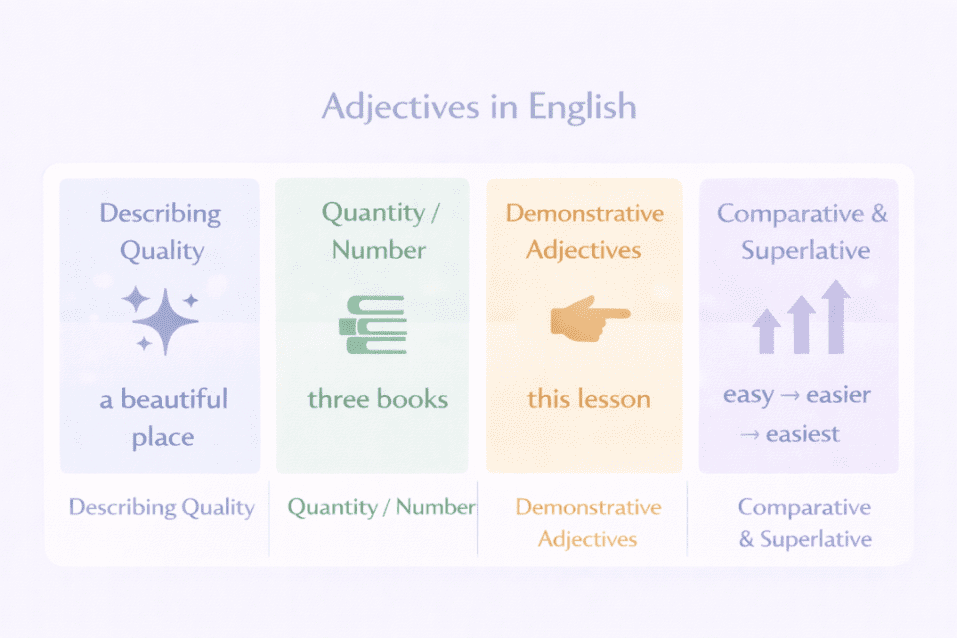
Adjectives – Types, Rules & Examples
What is an Adjective?
An adjective is a word that describes or gives more information about a noun or pronoun.
It tells us:
What kind?
How many?
Which one?
How much?
Adjectives make sentences clearer, richer, and more meaningful.
Examples of Adjectives
beautiful
good
many
this
important
Examples in sentences:
She is a good student.
English is an important language.
I bought three books.
Why Adjectives Are Important
Adjectives help us:
Describe people, places, and things clearly
Express opinions and qualities
Make writing and speaking more interesting
Compare:
❌ She bought a dress.
✅ She bought a beautiful dress.
Types of Adjectives in English
There are several types of adjectives based on how they are used.
Let’s understand them one by one.
1. Descriptive Adjectives
What are Descriptive Adjectives?
Descriptive adjectives describe the quality, size, shape, color, or condition of a noun.
Examples
happy, sad
big, small
red, blue
easy, difficult
Examples in sentences:
She is a confident speaker.
It was a difficult lesson.
He wore a blue shirt.
2. Quantitative Adjectives
What are Quantitative Adjectives?
Quantitative adjectives show how much or how many.
Examples
some, many, few
much, little
several, enough
Examples in sentences:
I have many books.
She has little time.
We need some help.
3. Numeral Adjectives
What are Numeral Adjectives?
Numeral adjectives show the exact number or order.
Examples
one, two, three
first, second, third
Examples in sentences:
She has two notebooks.
This is my first class.
He came second in the test.
4. Demonstrative Adjectives
What are Demonstrative Adjectives?
Demonstrative adjectives point out specific nouns.
Examples
| Adjective | Usage |
|---|---|
| this | near (singular) |
| that | far (singular) |
| these | near (plural) |
| those | far (plural) |
Examples in sentences:
This lesson is easy.
That book is mine.
These exercises are helpful.
Those students are late.
5. Possessive Adjectives
What are Possessive Adjectives?
Possessive adjectives show ownership.
Examples
my, your, his, her, its, our, their
Examples in sentences:
This is my notebook.
She forgot her phone.
They finished their work.
6. Interrogative Adjectives
What are Interrogative Adjectives?
Interrogative adjectives are used to ask questions.
Examples
which, what, whose
Examples in sentences:
Which book do you like?
What subject are you studying?
Whose bag is this?
7. Comparative and Superlative Adjectives
Comparative Adjectives
Used to compare two things.
Examples:
tall → taller
easy → easier
good → better
Example sentence:
English is easier than French.
Superlative Adjectives
Used to compare more than two things.
Examples:
tall → tallest
easy → easiest
good → best
Example sentence:
English is the most useful language for me.
Rules for Forming Comparatives and Superlatives
| Adjective | Comparative | Superlative |
|---|---|---|
| big | bigger | biggest |
| happy | happier | happiest |
| interesting | more interesting | most interesting |
Position of Adjectives in a Sentence
Adjectives usually come before the noun.
✅ a good student
✅ an important lesson
Sometimes they come after linking verbs.
✅ She is confident.
✅ The lesson seems easy.
Order of Adjectives
When more than one adjective is used, the usual order is:
Opinion → Size → Age → Color → Noun
Example:
a beautiful small old blue house
Common Adjective Mistakes to Avoid
❌ She is more smarter than him.
✅ She is smarter than him.
❌ He has many informations.
✅ He has much information.
❌ This is most easy lesson.
✅ This is the easiest lesson.
Practice Examples
Identify the adjective:
She bought a new phone.
English is an important language.
He solved the difficult problem.
This is the best option.
Why Learning Adjectives Is Important
Makes speech and writing descriptive
Helps express opinions clearly
Improves sentence quality
Essential for comparisons
Quick Summary
Adjectives describe nouns and pronouns
There are different types of adjectives
Comparatives compare two things
Superlatives compare more than two things
✅ Tip for Learners
When learning new vocabulary, always ask:
Can I use this word to describe a noun?
If yes → it’s likely an adjective.