
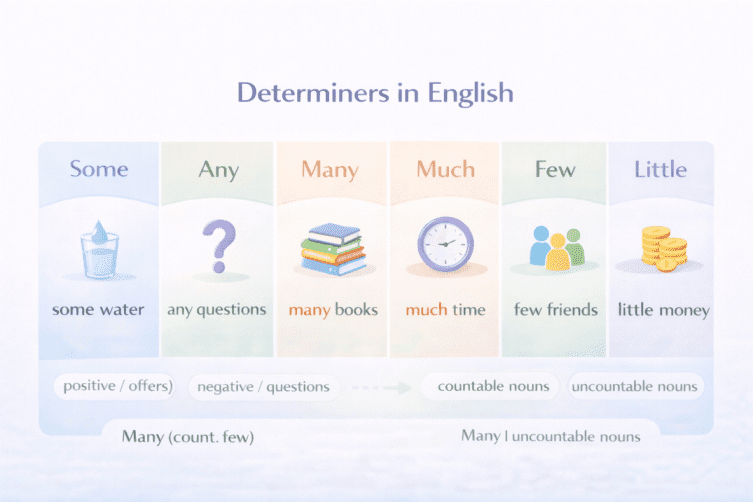
Determiners in English (Some, Any, Much, Many, Few, Little)
Determiners are small words, but they play a very important role in English.
They come before nouns and tell us:
how much
how many
how little
how few
Indian learners often confuse determiners because similar ideas are expressed differently in Indian languages.
This page explains the most common determiners in simple English, with clear examples.
What Are Determiners?
Determiners are words that come before a noun to give more information about quantity or amount.
Common determiners you must know:
some
any
much
many
few
little
Example:
some water
many students
few chances
Some vs Any (Very Important)
This is one of the most common confusions.
Some
Use some:
in positive sentences
in offers and requests
Examples
I have some time.
She bought some books.
Can I have some water?
Would you like some tea?
📌 Tip:
Even in questions, use some when you expect “yes”.
Any
Use any:
in negative sentences
in questions
when you don’t know or don’t care which one
Examples
I don’t have any money.
Do you have any questions?
Is there any problem?
Some vs Any – Quick Table
| Sentence Type | Use |
|---|---|
| Positive | some |
| Negative | any |
| Question | any |
| Offer / Request | some |
Much vs Many
These are used to talk about quantity.
Many
Use many with countable nouns (things you can count).
Examples
many books
many students
many questions
Sentence:
She has many friends.
Much
Use much with uncountable nouns (things you cannot count).
Examples
much water
much time
much money
Sentence:
I don’t have much time.
📌 Spoken English Tip:
In daily speech, people often use a lot of instead of much/many.
Few vs Little (Very Important Meaning Difference)
This part is critical for correct English.
Few
Use few with countable nouns.
few books
few opportunities
Meaning:
👉 almost none (negative meaning)
Example:
I have few friends.
(= almost no friends)
A Few
a few books
Meaning:
👉 some (positive meaning)
Example:
I have a few friends.
(= some friends)
Little
Use little with uncountable nouns.
little time
little money
Meaning:
👉 almost none (negative meaning)
Example:
I have little time.
(= almost no time)
A Little
a little time
Meaning:
👉 some (positive meaning)
Example:
I have a little time.
(= some time)
Few vs Little – Summary Table
| Word | Noun Type | Meaning |
|---|---|---|
| few | countable | almost none |
| a few | countable | some |
| little | uncountable | almost none |
| a little | uncountable | some |
Common Mistakes by Indian Learners
❌ I have many money.
✅ I have much money / a lot of money
❌ She has little friends.
✅ She has few friends
❌ Do you have some questions?
✅ Do you have any questions?
Very Simple Trick to Remember
Ask yourself two questions:
1️⃣ Can I count it?
Yes → many / few
No → much / little
2️⃣ Is the sentence positive or negative?
Positive → some
Negative / Question → any
Quick Practice (Try Now)
Fill in the blanks:
I don’t have ___ time.
She bought ___ vegetables.
Do you have ___ doubts?
He has ___ friends in the city.
Answers
much
some
any
few / a few (depends on meaning)
Spoken English Tip
In spoken English, it’s okay to say:
a lot of people
a lot of work
a lot of time
Fluency matters more than perfection.
Related Pages
Articles & Determiners in English
Definite vs Indefinite Articles
Common Article Mistakes by Indian Learners.
Final Advice
Determiners are about meaning, not memorization.
If you understand:
countable vs uncountable
positive vs negative meaning
You’ll use determiners correctly without thinking.