
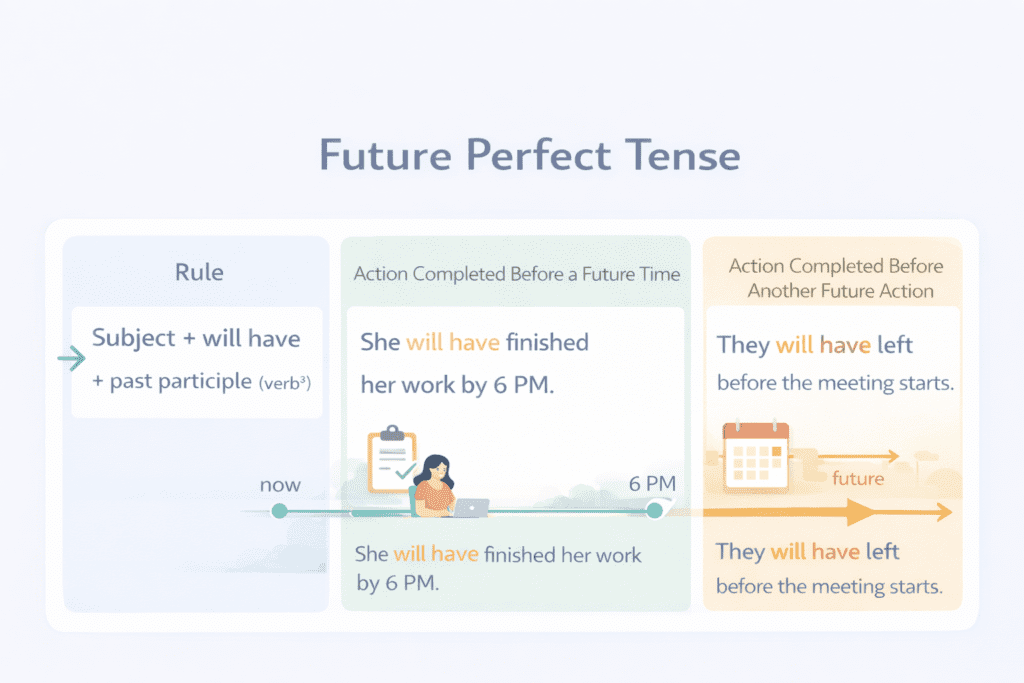
Future Perfect Tense – Rules, Uses & Examples
What is the Future Perfect Tense?
The Future Perfect Tense is used to talk about an action that will be completed before a specific time or another action in the future.
In simple words, it answers this question:
What will be finished before a certain future time?
This tense focuses on the completion of an action in the future, not on how long it takes.
Structure of the Future Perfect Tense
The basic structure is:
Subject + will have + past participle (verb³)
Examples:
I will have completed the course by June.
She will have finished her work before dinner.
They will have reached home by 9 PM.
👉 “Will have” is used for all subjects.
Uses of the Future Perfect Tense
1. Action Completed Before a Specific Time in the Future
This is the most common use of the future perfect tense.
Use it when you want to say that an action will be finished before a particular future time.
Examples:
I will have finished the assignment by tomorrow.
She will have learned basic English by next month.
We will have left the office by 6 PM.
Common time expressions:
by tomorrow, by next week, by 2026, by 8 PM
2. Action Completed Before Another Future Action
Use this tense when two future actions are mentioned and you want to show which one will happen first.
The earlier action → Future Perfect
The later action → Present Simple / Future Simple
Examples:
I will have completed the report before the meeting starts.
She will have cooked dinner before the guests arrive.
They will have booked the tickets before prices increase.
3. To Show Expectations About Completion
Use the future perfect tense to talk about what you expect to be completed by a certain time.
Examples:
He will have achieved his goals by the end of the year.
She will have improved her pronunciation soon.
We will have solved the problem by tomorrow.
Sentence Forms
Affirmative Sentences
Subject + will have + past participle
Examples:
I will have learned many new words.
She will have completed all lessons.
They will have prepared everything.
Negative Sentences
Subject + will not have + past participle
Examples:
I will not have finished the work by today.
She will not have joined the course by then.
They will not have decided yet.
Short form:
will not → won’t
Interrogative Sentences (Questions)
Will + subject + have + past participle?
Examples:
Will you have completed the course by June?
Will she have finished the project?
Will they have arrived by evening?
Wh-Questions
Wh-word + will + subject + have + past participle?
Examples:
When will you have completed the course?
How much work will she have finished?
Why will they have left early?
Common Time Expressions Used
by tomorrow
by next week / month / year
by the time
before
in two hours (from now)
Examples:
I will have finished the lesson by tonight.
She will have joined the company by next month.
They will have reached home by the time we call.
Common Mistakes to Avoid
❌ I will have finish the work by today.
✅ I will have finished the work by today.
❌ She will has completed the task.
✅ She will have completed the task.
❌ Will you have complete the lesson?
✅ Will you have completed the lesson?
Future Simple vs Future Perfect
| Future Simple | Future Perfect |
|---|---|
| Action will happen | Action will be completed |
| “I will finish” | “I will have finished” |
| Focus on action | Focus on completion |
Example Comparison:
I will finish the course next month.
I will have finished the course by next month.
Future Perfect vs Future Continuous
| Future Continuous | Future Perfect |
|---|---|
| Action in progress | Action completed |
| “I will be studying” | “I will have studied” |
| Focus on duration | Focus on result |
More Examples for Practice
I will have improved my English by the end of this year.
She will have attended all classes by Friday.
We will have completed the grammar section.
They will have achieved fluency with practice.
Quick Summary
Used for actions completed before a future time
Structure: will have + verb³
Often used with by and before
Focuses on completion, not duration
✅ Tip for Learners
If you want to say that something will be finished before a specific future time, always use the future perfect tense.