
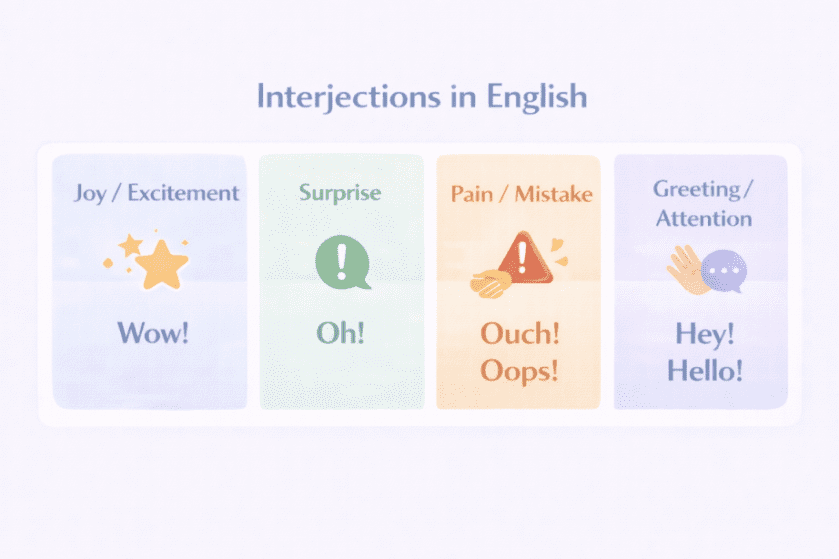
Interjections – Uses & Examples
What is an Interjection?
An interjection is a word or short expression that shows a sudden feeling or emotion.
It can express:
happiness
surprise
pain
anger
excitement
approval
Interjections often stand alone and are followed by an exclamation mark (!).
Examples of Interjections
wow!
oh!
hey!
oops!
ah!
bravo!
Examples in sentences:
Wow! That was an amazing shot.
Oh! I didn’t know that.
Oops! I made a mistake.
Why Interjections Are Important
Interjections help us:
Express emotions naturally
Sound more human and fluent
Make conversations lively
React instantly in spoken English
Without interjections, speech sounds flat and robotic.
Common Interjections in English
Some commonly used interjections are:
oh, wow, hey, ah, oops, alas, bravo, huh, hmm, yay
Types of Interjections
Interjections can be grouped based on the emotion they express.
1. Interjections of Joy or Happiness
Used to express happiness, excitement, or pleasure.
Examples
wow!
yay!
hooray!
bravo!
Examples in sentences:
Yay! We won the match.
Wow! That’s a beautiful place.
Bravo! Well done.
2. Interjections of Surprise
Used when something unexpected happens.
Examples
oh!
ah!
what!
really!
Examples in sentences:
Oh! I didn’t expect that.
Ah! Now I understand.
What! Are you serious?
3. Interjections of Pain or Discomfort
Used to express physical or emotional pain.
Examples
ouch!
oh no!
alas!
Examples in sentences:
Ouch! That hurt.
Oh no! I lost my phone.
Alas! We missed the opportunity.
4. Interjections of Attention or Greeting
Used to get someone’s attention or greet them.
Examples
hey!
hello!
hi!
Examples in sentences:
Hey! Listen to me.
Hello! How are you?
Hi! Nice to meet you.
5. Interjections of Approval or Agreement
Used to show approval or agreement.
Examples
yes!
okay!
right!
Examples in sentences:
Yes! That’s correct.
Okay! I agree.
Right! Let’s do that.
Punctuation with Interjections
Interjections are usually followed by:
Exclamation mark (!) → strong emotion
Comma (,) → mild emotion
Examples:
Wow! That’s amazing.
Oh, I see now.
Interjections in Spoken vs Written English
Spoken English → used very often
Formal writing → used rarely
Examples in spoken English:
Oops! I forgot.
Hey! Wait for me.
In formal writing, avoid too many interjections.
Common Mistakes to Avoid
❌ Wow that is great.
✅ Wow! That is great.
❌ Ouch I hurt my leg.
✅ Ouch! I hurt my leg.
❌ He said wow.
✅ He said, “Wow!”
Practice Examples
Identify the interjection:
Oops! I dropped the glass.
Wow! That was a close match.
Hey! Don’t touch that.
Oh no! We are late.
Why Learning Interjections Is Useful
Makes English sound natural
Helps express emotions clearly
Improves spoken communication
Important for real-life conversations
Quick Summary
Interjections express sudden feelings
They can stand alone
Often followed by an exclamation mark
Mostly used in spoken English
✅ Tip for Learners
Use interjections naturally, not in every sentence.
One good interjection at the right time is better than many.