
Nouns – Types, Rules & Examples
What is a Noun?
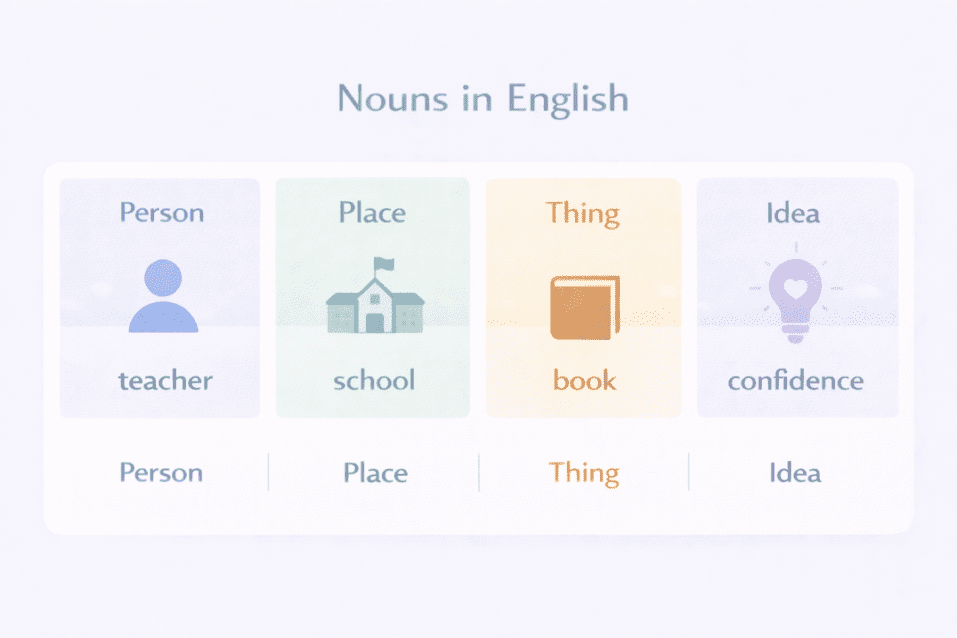
A noun is a word used to name:
A person
A place
A thing
An idea or quality
Nouns are one of the most important parts of speech because almost every sentence in English contains a noun.
Examples of Nouns
Person: teacher, student, doctor
Place: school, city, India
Thing: book, phone, computer
Idea: confidence, honesty, freedom
Examples in sentences:
English grammar is important.
She lives in Mumbai.
Practice improves fluency.
Types of Nouns in English
There are several types of nouns, each with a specific purpose.
Let’s understand them one by one.
1. Common Nouns
What is a Common Noun?
A common noun refers to a general name of a person, place, or thing.
It does not start with a capital letter unless it appears at the beginning of a sentence.
Examples of Common Nouns
boy, girl, teacher
city, school, country
book, pen, laptop
Examples in sentences:
The teacher explained the lesson.
She lives in a big city.
I bought a new book.
2. Proper Nouns
What is a Proper Noun?
A proper noun is the specific name of a person, place, or thing.
It always starts with a capital letter.
Examples of Proper Nouns
Person: Rahul, Priya, John
Place: India, Mumbai, London
Thing: English, Google, Monday
Examples in sentences:
Rahul is learning English.
She lives in Mumbai.
We study English daily.
3. Concrete Nouns
What is a Concrete Noun?
A concrete noun refers to something that can be:
Seen
Touched
Heard
Smelled
Tasted
In simple words, it can be experienced by the senses.
Examples of Concrete Nouns
apple, chair, music
dog, water, phone
Examples in sentences:
I ate an apple.
The dog is barking.
She bought a new phone.
4. Abstract Nouns
What is an Abstract Noun?
An abstract noun refers to something that:
Cannot be seen or touched
Is an idea, feeling, quality, or state
Examples of Abstract Nouns
love, happiness, courage
honesty, confidence, success
Examples in sentences:
Confidence helps you speak better.
Honesty is an important quality.
He achieved success through hard work.
5. Collective Nouns
What is a Collective Noun?
A collective noun refers to a group of people, animals, or things considered as one unit.
Examples of Collective Nouns
a team of players
a group of students
a flock of birds
a class of learners
Examples in sentences:
The team won the match.
The class is very attentive.
A flock of birds flew away.
6. Countable Nouns
What is a Countable Noun?
A countable noun refers to something that:
Can be counted
Has singular and plural forms
Examples of Countable Nouns
book → books
chair → chairs
student → students
Examples in sentences:
I have two books.
She bought three pens.
There are many students in the class.
7. Uncountable Nouns
What is an Uncountable Noun?
An uncountable noun refers to something that:
Cannot be counted individually
Usually does not have a plural form
Examples of Uncountable Nouns
water, milk, sugar
information, advice, furniture
Examples in sentences:
I need some water.
She gave me useful advice.
The room has new furniture.
👉 We do not say informations or advices.
Countable vs Uncountable Nouns
| Countable | Uncountable |
|---|---|
| one book | water |
| two pens | milk |
| many chairs | information |
Common Noun Mistakes to Avoid
❌ She gave me many advices.
✅ She gave me much advice.
❌ I bought furnitures.
✅ I bought furniture.
❌ The honesty is important.
✅ Honesty is important.
How to Identify a Noun
Ask these questions:
Is it a name?
Can I count it?
Is it an idea or feeling?
Is it a place or thing?
If yes → it is likely a noun.
Practice Examples
Identify the type of noun:
India → Proper noun
Happiness → Abstract noun
Students → Countable noun
Water → Uncountable noun
Team → Collective noun
Why Nouns Are Important
They are the building blocks of sentences
Help identify who or what the sentence is about
Essential for correct sentence formation
Quick Summary
Nouns name people, places, things, or ideas
There are different types of nouns
Some nouns are countable, others are uncountable
Correct noun usage improves clarity and fluency
✅ Tip for Learners
When unsure about plural forms, ask:
Can I count it one by one?
If yes → countable
If no → uncountable