
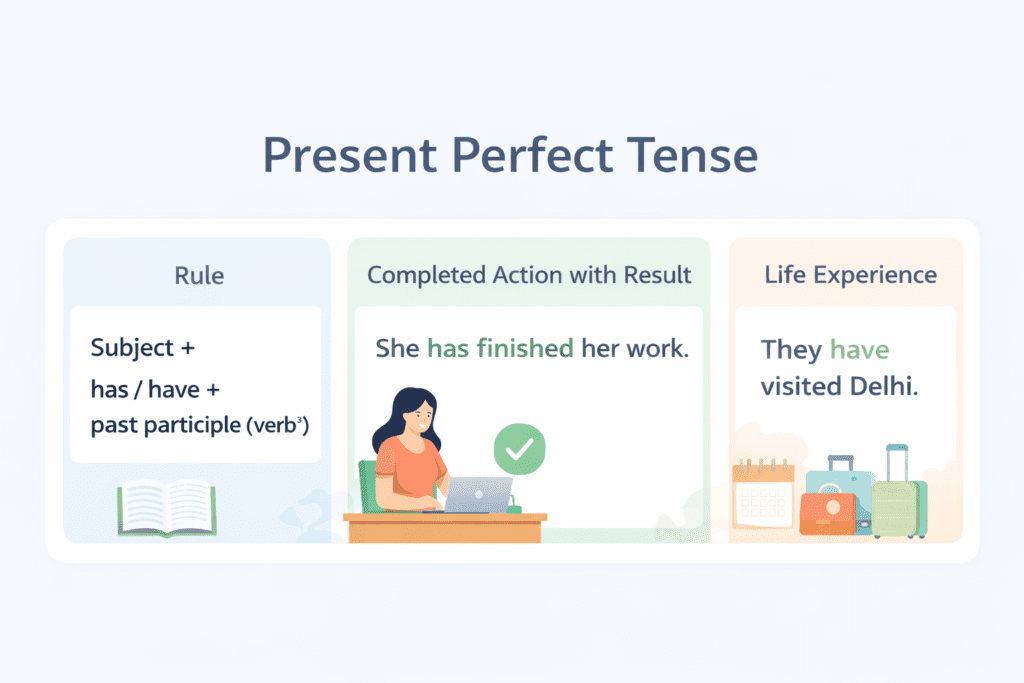
Present Perfect Tense – Rules, Uses & Examples
What is the Present Perfect Tense?
The Present Perfect Tense is used to talk about actions that are completed in the past, but their effect or relevance is connected to the present.
Unlike the simple past tense, the present perfect tense does not focus on when the action happened. Instead, it focuses on the result or experience.
This tense is very commonly used in spoken and written English, especially in daily conversations, interviews, and professional communication.
Structure of the Present Perfect Tense
The basic structure is:
Subject + has / have + past participle (verb³)
Examples:
I have finished my work.
She has learned English grammar.
They have visited Mumbai.
Helping Verbs Used
| Subject | Helping Verb |
|---|---|
| I / You / We / They | have |
| He / She / It | has |
Past Participle (Verb³)
Regular verbs: add -ed
work → worked
play → played
Irregular verbs: change form
go → gone
eat → eaten
write → written
👉 Learning irregular verbs is important to use this tense correctly.
Uses of the Present Perfect Tense
1. Actions Completed Recently
Use the present perfect tense for actions that were completed a short time ago, but the result is important now.
Examples:
I have just completed the assignment.
She has finished her lunch.
We have booked the tickets.
Common words used:
just, recently, already
2. Life Experiences (No Time Mentioned)
Use this tense to talk about experiences in life, without mentioning a specific time.
Examples:
I have visited Goa.
He has watched this movie.
They have tried online English classes.
❌ Do not mention exact time:
❌ I have visited Goa last year
✅ I visited Goa last year
3. Actions That Started in the Past and Continue Till Now
Use the present perfect tense to show actions that started in the past and are still continuing.
Examples:
I have lived in Mumbai for 5 years.
She has worked here since 2020.
We have known each other for a long time.
Common words used:
since, for
4. Repeated Actions Until Now
Use this tense for actions that have happened many times up to the present.
Examples:
I have read this book many times.
He has missed several classes.
They have called her repeatedly.
5. Unfinished Time Periods
Use it when the time period is not finished yet.
Examples:
I have spoken to my manager today.
She has completed two lessons this week.
We have attended three meetings this month.
Sentence Forms
Affirmative Sentences
Subject + has / have + past participle
Examples:
I have improved my English.
She has joined a new course.
They have completed the project.
Negative Sentences
Subject + has / have + not + past participle
Examples:
I have not finished my homework.
He has not replied yet.
We have not decided anything.
Short forms:
have not → haven’t
has not → hasn’t
Interrogative Sentences (Questions)
Has / Have + subject + past participle?
Examples:
Have you completed the task?
Has she called you?
Have they arrived safely?
Wh-Questions
Wh-word + has / have + subject + past participle?
Examples:
What have you done?
Why has he left early?
How many times have you visited Delhi?
Common Time Words Used
already
yet
just
ever
never
since
for
Examples:
I have already finished.
She hasn’t called yet.
Have you ever tried this app?
Common Mistakes to Avoid
❌ I have done this yesterday.
✅ I did this yesterday.
❌ She has went to office.
✅ She has gone to office.
❌ He have completed the work.
✅ He has completed the work.
Present Perfect vs Past Simple
| Present Perfect | Past Simple |
|---|---|
| Result matters | Time matters |
| No exact time | Exact time mentioned |
| “I have finished” | “I finished yesterday” |
More Examples for Practice
I have learned many new words.
She has improved her pronunciation.
We have completed 10 grammar lessons.
They have joined an English course.
Quick Summary
Talks about past actions with present relevance
Uses has / have + verb³
Used for experiences, recent actions, continuation
Avoid using specific past time words
✅ Tip for Learners
When you are not sure when something happened, use the present perfect tense.