
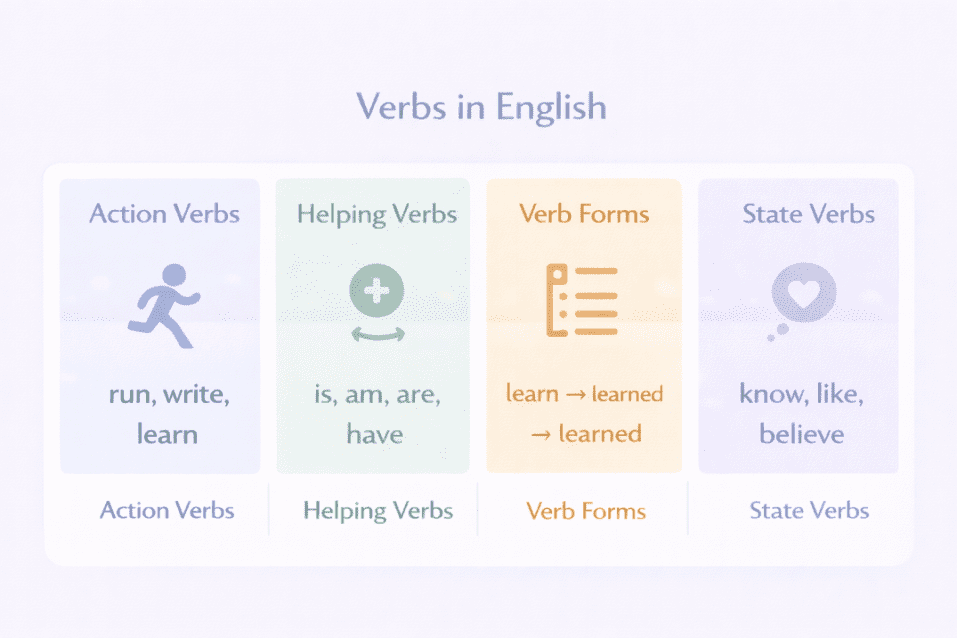
Verbs – Types, Forms & Examples
What is a Verb?
A verb is a word that shows:
An action
A state
Or an occurrence
Every complete sentence in English must have a verb.
Without a verb, a sentence is incomplete.
Examples of Verbs
Action: run, speak, write
State: is, am, are
Occurrence: become, grow
Examples in sentences:
She learns English.
They are practicing daily.
He became confident.
Why Verbs Are Important
Verbs tell us:
What someone does
What something is
What happens in a sentence
Without verbs:
There is no action
There is no meaning
There is no sentence
Types of Verbs in English
English verbs can be divided into different types based on how they are used.
Let’s understand them one by one.
1. Action Verbs
What are Action Verbs?
Action verbs show physical or mental actions.
Examples of Action Verbs
Physical actions: run, write, eat
Mental actions: think, learn, remember
Examples in sentences:
She writes emails daily.
They practice English every day.
I think this is useful.
2. Helping Verbs (Auxiliary Verbs)
What are Helping Verbs?
Helping verbs are used with main verbs to show:
Tense
Time
Continuity
Completion
Common Helping Verbs
am, is, are
was, were
has, have, had
will, shall
Examples in Sentences
She is learning English.
They have completed the lesson.
I will attend the class tomorrow.
3. Main Verbs
What are Main Verbs?
A main verb shows the main action or state in a sentence.
Examples
learn
speak
work
study
Examples in sentences:
She learns English.
He works in an office.
They study together.
4. Linking Verbs
What are Linking Verbs?
Linking verbs connect the subject to more information about the subject.
They do not show action.
Common Linking Verbs
is, am, are
was, were
seem, become, feel, look
Examples
She is confident.
He seems tired.
Learning English becomes easier with practice.
5. State Verbs (Stative Verbs)
What are State Verbs?
State verbs show:
Feelings
Thoughts
Possession
States of being
They are usually not used in continuous form.
Common State Verbs
know, like, love
believe, understand
have, own, belong
Examples
I know the answer.
She likes English.
He has a laptop.
❌ I am knowing the answer.
✅ I know the answer.
Forms of Verbs
Most verbs have three main forms:
| Form | Example (learn) |
|---|---|
| Base form | learn |
| Past form | learned |
| Past participle | learned |
Examples in Sentences
Present: I learn English.
Past: I learned English last year.
Perfect: I have learned English online.
Regular Verbs
What are Regular Verbs?
Regular verbs form the past tense by adding -ed.
Examples
work → worked
play → played
learn → learned
Examples in sentences:
She worked late yesterday.
They played well.
I learned new words.
Irregular Verbs
What are Irregular Verbs?
Irregular verbs do not follow a fixed pattern in the past tense.
Examples
| Base | Past | Past Participle |
|---|---|---|
| go | went | gone |
| eat | ate | eaten |
| see | saw | seen |
Examples in sentences:
She went home early.
I have seen this lesson.
They ate together.
Transitive and Intransitive Verbs
Transitive Verbs
Need an object.
She reads a book.
He completed the task.
Intransitive Verbs
Do not need an object.
He slept.
The baby cried.
Common Verb Mistakes to Avoid
❌ She learning English.
✅ She is learning English.
❌ He don’t like English.
✅ He doesn’t like English.
❌ I am agree with you.
✅ I agree with you.
Practice Examples
Identify the verb type:
She is studying → Helping + main verb
He knows the answer → State verb
They played cricket → Action verb
She became confident → Linking verb
Why Learning Verbs Is Important
Verbs give meaning to sentences
Help express time and action
Improve speaking accuracy
Essential for all tenses
Quick Summary
Verbs show action or state
Every sentence needs a verb
There are different types of verbs
Verbs change form based on tense
✅ Tip for Learners
If a sentence feels incomplete, check:
Is there a verb in the sentence?
If not, the sentence is not complete.