
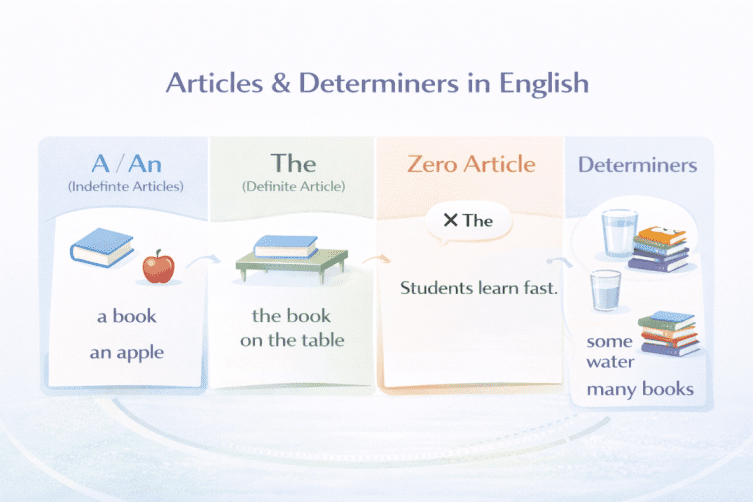
Articles & determiners are small words, but they create big confusion for English learners—especially Indian learners.
This section explains:
-
When to use a / an / the
-
When to use no article (zero article)
-
Common mistakes Indians make
-
How to use some, any, much, many, few, little
What Are Articles in English?
Articles are words that come before a noun.
The three articles in English:
-
a
-
an
-
the
They tell us:
-
Is the noun general or specific?
-
Is it new or already known?
Definite vs Indefinite Articles
This is the most important concept.
Indefinite Articles: A / An
Use a / an when:
-
You talk about something for the first time
-
The listener does not know which one
-
You mean one of many
A vs An
-
a → before consonant sound
a book, a university -
an → before vowel sound
an apple, an hour
Examples
-
I saw a dog on the road.
-
She bought an umbrella.
-
He is a teacher.
📌 Key idea:
“A / An = not specific”
Definite Article: The
Use the when:
-
The noun is specific
-
Both speaker and listener know it
-
It was mentioned before
Examples
-
I saw a dog. The dog was very friendly.
-
Please close the door.
-
She is sitting in the room.
📌 Key idea:
“The = specific / already known”
A vs The – Simple Comparison
| Sentence | Meaning |
|---|---|
| I need a pen | Any pen |
| I need the pen | A specific pen |
| She lives in a house | Any house |
| She lives in the house | A particular house |
Zero Article – When NOT to Use an Article
Many learners overuse articles.
Sometimes, no article is correct.
Do NOT use articles with:
1️⃣ General plural nouns
-
❌ The students like music
-
✅ Students like music
2️⃣ Uncountable nouns (general meaning)
-
❌ The water is important
-
✅ Water is important
3️⃣ Languages & subjects
-
❌ The English is easy
-
✅ English is easy
4️⃣ Meals (general)
-
❌ I eat the breakfast at 9
-
✅ I eat breakfast at 9
Zero Article – Examples
-
Life is unpredictable.
-
Children learn fast.
-
Money is important.
-
Cricket is popular in India.
📌 Tip for Indian learners:
If you mean something in general, try no article first.
Common Article Mistakes by Indian Learners
These mistakes are extremely common.
❌ Mistake 1: Using “the” before everything
-
❌ The life is difficult
-
✅ Life is difficult
❌ Mistake 2: Using article before proper nouns
-
❌ The India is beautiful
-
✅ India is beautiful
❌ Mistake 3: Missing article where needed
-
❌ She is teacher
-
✅ She is a teacher
❌ Mistake 4: Wrong a / an usage
-
❌ An university
-
✅ A university
(University starts with “you” sound)
What Are Determiners?
Determiners come before nouns, just like articles.
They give information about:
-
quantity
-
amount
-
choice
Articles are also determiners, but here we focus on quantity determiners.
Common Determiners in English
Some / Any
Much / Many
Few / Little
Some vs Any
Some
-
Used in positive sentences
-
Used in offers & requests
Examples
-
I have some time.
-
She bought some books.
-
Can I have some water?
Any
-
Used in negative sentences
-
Used in questions
Examples
-
I don’t have any money.
-
Do you have any questions?
Much vs Many
Many → countable nouns
-
many books
-
many students
Much → uncountable nouns
-
much time
-
much water
Examples
-
She has many friends.
-
I don’t have much time.
📌 In spoken English, people often say:
a lot of instead of much/many
Few vs Little
This part is very important.
Few → countable nouns
-
few books
-
few opportunities
Little → uncountable nouns
-
little time
-
little money
Meaning Difference
| Word | Meaning |
|---|---|
| few | almost none (negative) |
| a few | some (positive) |
| little | almost none (negative) |
| a little | some (positive) |
Examples
-
I have few friends (almost none)
-
I have a few friends (some friends)
Daily Practice Tip
Try this exercise daily:
1️⃣ Read one sentence
2️⃣ Remove the article
3️⃣ Add the correct article again
Example:
-
She is ___ engineer.
Answer: an
Final Advice
Articles and determiners are not about rules only.
They are about meaning.
👉 Ask yourself:
-
Is it general or specific?
-
Is it countable or uncountable?
-
Is the listener already aware?
With practice, this becomes natural.